Chinese Calligraphy · Unit 3 · Lesson 10 · 書法 單元三 第十課
What Treasures of Calligraphy Can You See in Taiwan?故宮裡的書法國寶
A letter about snow, a draft full of grief, a monk's wild cursive, a book about writing, and two poems from exile: five National Treasures of calligraphy are kept in Taipei. Walk through a 3D gallery, find out why the lights are so low, match details to the works, and look back over all ten lessons. 一封談雪的短信、一篇滿紙悲傷的草稿、一位和尚的狂草、一卷談寫字的書、兩首貶謫中寫的詩——五件書法國寶就收藏在台北。走進 3D 展廳,看看燈光為什麼這麼暗,用局部圖配對作品,再回顧這十堂課。
Big idea · 一句話看懂
Some of the most famous works of Chinese calligraphy are kept in the National Palace Museum in Taipei, and many are National Treasures. Paper and silk are harmed by light, and the harm adds up, so the museum keeps the lights low, shows each work for only a short time, and then lets it rest. 許多最有名的書法作品收藏在台北的國立故宮博物院,其中不少是國寶。紙和絹怕光,而且光造成的傷害會累積,所以博物館把燈光調暗、每件作品只展出很短的時間,展完還要讓它休息。
3D Model · 3D 模型
A Gallery of Five Treasures, and Why the Lights Are Low 五件國寶的展廳,和燈光為什麼這麼暗
Drag to look around, and scroll or pinch to zoom. Tap a work to walk up to it and read who wrote it, when, and in which script. Then choose Light: turn the light up, show a test strip for a year, and see why museums keep these rooms dim. 拖曳可以環顧四周,滾輪或雙指可以縮放。點一件作品走近看:誰寫的、什麼時候、用哪一種字體。再選「燈光」:把燈調亮,讓一條試紙展出一年,看看博物館為什麼把展廳的燈開得這麼暗。
Drag to look around · 拖曳環顧 Scroll or pinch to zoom · 滾輪/雙指縮放 Tap a work · 點作品走近
This 3D model needs WebGL, which this browser does not support. The reading, the five works, the game, and the practice pad below still work. 這個瀏覽器不支援 WebGL,無法顯示 3D 模型;下方的課文、五件作品、小遊戲和練字板一樣能用。
Warm spotlights: one for each work 暖色的投射燈:每件作品一盞
Yellow label: the half of the strip in the light 黃色標籤:試紙照到光的那一半
Dark card: the half that stays covered 深色卡紙:一直蓋住的那一半
A teaching model, not the real galleries: the room is our own simple design and the works are not to scale (all five are less than 35 cm tall). For the three long scrolls, the wall shows only the opening part or the main part. The light numbers are real: the museum's rules give 50 lux as the limit for paintings and calligraphy, and 16,000 lux-hours a year for its most protected works (for example, 50 lux for 8 hours a day for 40 days). The fading of the test strip is only an illustration of how light adds up; it is not a measurement of any real work, and the works on the wall never fade in the model. 這是教學用的示意模型,不是真的展廳:房間是我們自己設計的,作品也不是照比例(五件的高度都不到 35 公分)。三件長卷在牆上只放了開頭或主要的一段。燈光的數字是真的:故宮的規定是書畫照度不高於 50 lux,限展書畫一年累積不高於 16,000 lux・小時(例如 50 lux、每天 8 小時,可展 40 天)。試紙褪色的快慢只是用來說明「光會累積」的示意,不是任何一件文物的實測;牆上的作品在模型裡不會褪色。
Gallery model drawn and programmed by My Culture Connect. Works on the wall: 晉王羲之快雪時晴帖 冊。國立故宮博物院,台北,CC BY 4.0 @ www.npm.gov.tw(經裁切) 唐孫過庭書譜 卷。國立故宮博物院,台北,CC BY 4.0 @ www.npm.gov.tw(經裁切、拼接) 唐顏真卿祭姪文稿 卷。國立故宮博物院,台北,CC BY 4.0 @ www.npm.gov.tw(經裁切、拼接) 唐懷素自敘帖 卷。國立故宮博物院,台北,CC BY 4.0 @ www.npm.gov.tw(經裁切、拼接) 北宋蘇東坡書黃州寒食詩 卷。國立故宮博物院,台北,CC BY 4.0 @ www.npm.gov.tw(經裁切、拼接)
Reading · 英文閱讀
10
Unit 10: What Treasures of Calligraphy Can You See in Taiwan?
Where can you see the real writing of the masters in this series? One answer is Taipei. The National Palace Museum there keeps more than 3,700 works of calligraphy, and some of them are among the most famous in the world.
The museum began in 1925 in the old palace in Beijing. In 1933, as war came closer, more than thirteen thousand crates of its treasures were sent south for safety. In 1948 and 1949, a selection of the finest pieces was shipped to Taiwan, and in 1965 a new museum building opened in Taipei.
This lesson looks at five works. Two were written by people you have already met: a short letter by Wang Xizhi, kept as a fine Tang dynasty copy, and Yan Zhenqing's draft for his nephew. Two are in cursive script: Sun Guoting's long scroll about how to write, and the wild cursive of the monk Huaisu. The last is by the Song dynasty poet Su Shi.
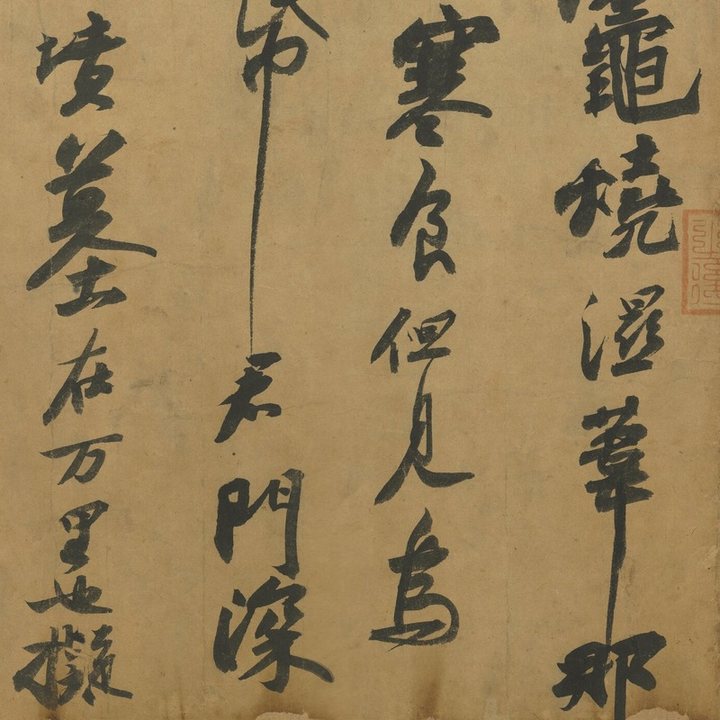
In 1080 Su Shi was sent away from the capital to live in Huangzhou. During his third Cold Food Festival there, in 1082, it rained and rained, and he wrote two sad poems. On the scroll, the characters begin small and grow larger and heavier as his feelings rise. The lower edge of the scroll is marked by fire. It was once taken to Japan, and the museum bought it in 1987.
You cannot see these works every day. Paper and silk are fragile, and light harms them a little at a time. The harm adds up and cannot be undone. So the museum keeps paintings and calligraphy at no more than 50 lux, which is far dimmer than daylight. Its most protected works may be shown for no more than 42 days, and then they rest for at least three years.
All five are National Treasures. After ten lessons, you can read them in a new way: you know the scripts, the strokes, and how a brush makes thick and thin lines. If you visit, walk slowly, look closely, and never use a flash.
What happens to the characters in Su Shi's scroll as the poems go on?
They begin small and grow larger and heavier as his feelings rise.
Why does the museum show its most protected works for only a short time?
Because light harms paper and silk a little at a time, and the harm adds up and cannot be undone.
Words & Phrases · 生字及片語
museum(n.)博物館Our class visited a science museum last week.我們班上星期去參觀科學博物館。collection(n.)收藏;藏品My uncle has a large collection of stamps.我叔叔收藏了很多郵票。fragile(adj.)脆弱的;易碎的Be careful with that box: the glasses inside are fragile.小心那個箱子,裡面的玻璃杯很容易破。protect(v.)保護A helmet protects your head.安全帽保護你的頭。dim(adj.)昏暗的It is hard to read in dim light.光線昏暗的時候很難看書。harm(v. / n.)傷害Too much sun can harm your skin.曬太多太陽會傷害皮膚。festival(n.)節日We eat mooncakes at the Mid-Autumn Festival.我們在中秋節吃月餅。visit(v. / n.)參觀;拜訪We visit my grandparents every Sunday.我們每個星期天去看爺爺奶奶。
Quick Check · 小測驗
1. Where are these five works kept?
2. Which script did the monk Huaisu use in his Autobiography?
3. Who wrote the two Cold Food poems in Huangzhou?
4. What is the museum's light limit for paintings and calligraphy?
5. Why must you never use a flash in the galleries?
In Order · 排年代
Seven hundred years on one line 一條線上的七百年
From Wang Xizhi's time to Su Shi's is about seven hundred years. Three of the five works were written within ninety years of each other in the Tang dynasty. 從王羲之到蘇軾,大約七百年。五件裡有三件是唐朝寫的,前後相差不到九十年。
300sJin晉Timely Clearing After Snowfall快雪時晴帖Wang Xizhi's letter; what survives is a Tang tracing copy.王羲之的信;留下來的是唐代的精摹本。
687Tang唐Treatise on Calligraphy書譜Sun Guoting, cursive script.孫過庭,草書。
758Tang唐Draft of a Requiem to My Nephew祭姪文稿Yan Zhenqing, running script.顏真卿,行書。
1082Song宋The Cold Food Observance寒食帖Su Shi's poems of 1082; the scroll was written then or soon after.蘇軾 1082 年作的詩;這卷字寫於當時或稍後。
Game · 小遊戲
Which Work Is It? 這是哪一件?
Here is a small piece of one of the five works. Which one is it from? Use what you know about scripts, ink, and the size of the characters. 這是五件作品其中一件的一小塊。它出自哪一件?用你學過的字體、墨色和字的大小來判斷。
Right on the first try一次就答對0 / 10
Details of five works in the National Palace Museum, Taipei. 晉王羲之快雪時晴帖 冊。國立故宮博物院,台北,CC BY 4.0 @ www.npm.gov.tw(經裁切) 唐孫過庭書譜 卷。國立故宮博物院,台北,CC BY 4.0 @ www.npm.gov.tw(經裁切、拼接) 唐顏真卿祭姪文稿 卷。國立故宮博物院,台北,CC BY 4.0 @ www.npm.gov.tw(經裁切、拼接) 唐懷素自敘帖 卷。國立故宮博物院,台北,CC BY 4.0 @ www.npm.gov.tw(經裁切、拼接) 北宋蘇東坡書黃州寒食詩 卷。國立故宮博物院,台北,CC BY 4.0 @ www.npm.gov.tw(經裁切、拼接)
Five Treasures · 五件國寶
Look closely: a detail from each 靠近一點看:每一件的局部
These are real details from the five works, from the museum's open data. Before you read the caption, ask yourself: which script is it? Is the ink wet or dry? Do the characters stay the same size? 這是五件作品真的局部,來自故宮的開放資料。先別看說明,問問自己:這是哪一種字體?墨是濕的還是乾的?字的大小一樣嗎?
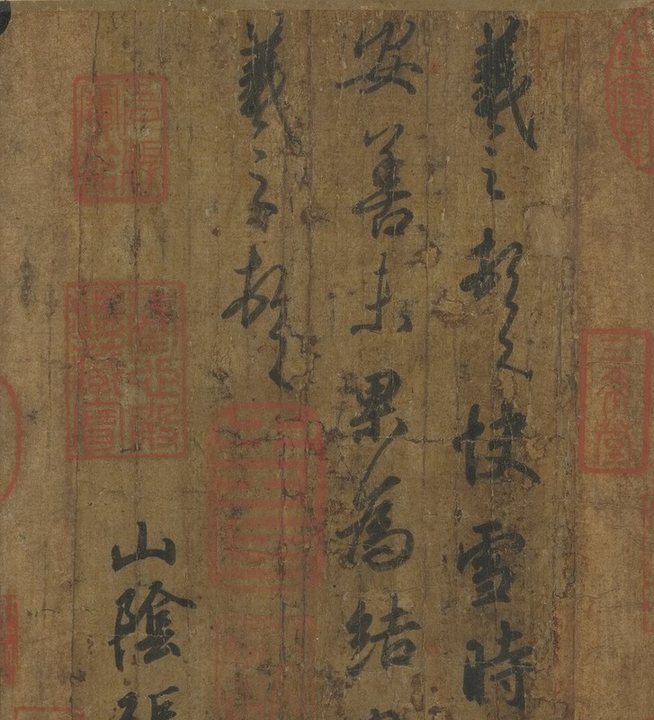
Timely Clearing After Snowfall · Wang Xizhi (Jin dynasty)〈快雪時晴帖〉・王羲之(晉)
Running script; a Tang dynasty tracing copy. Four short lines of calm running script, with many red seals around them. 行書;唐代的精摹本。四行從容的行書,周圍蓋了很多紅色的印章。
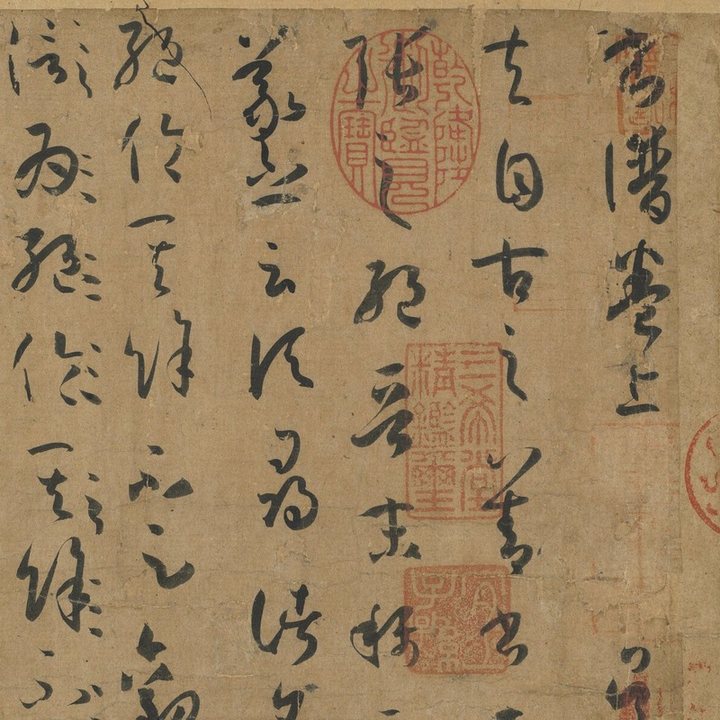
晉王羲之快雪時晴帖 冊。國立故宮博物院,台北,CC BY 4.0 @ www.npm.gov.tw(經裁切)Treatise on Calligraphy · Sun Guoting (Tang dynasty)〈書譜〉・孫過庭(唐)
Cursive script; 687. Small, quick cursive in neat columns: each character stands alone. 草書;垂拱三年(687)。小小的、寫得很快的草書,一行一行很整齊,字和字多半不相連。
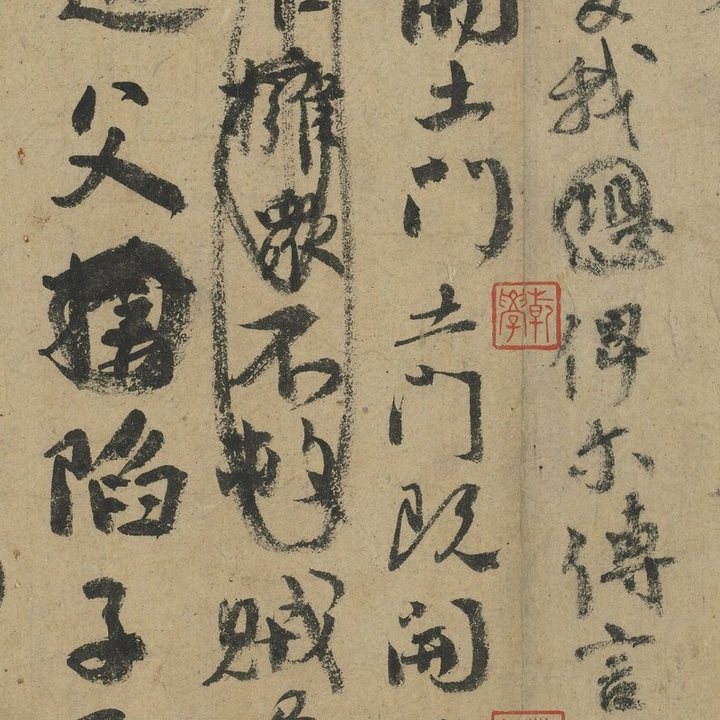
唐孫過庭書譜 卷。國立故宮博物院,台北,CC BY 4.0 @ www.npm.gov.tw(經裁切、拼接)Draft of a Requiem to My Nephew · Yan Zhenqing (Tang dynasty)〈祭姪文稿〉・顏真卿(唐)
Running script; 758. A draft: look for dry, scratchy ink and words crossed out. 行書;乾元元年(758)。這是草稿:找找乾乾的枯筆,和塗掉的字。
唐顏真卿祭姪文稿 卷。國立故宮博物院,台北,CC BY 4.0 @ www.npm.gov.tw(經裁切、拼接)Autobiography · Huaisu (Tang dynasty)〈自敘帖〉・懷素(唐)
Wild cursive script; 777. Wild cursive: thin, round lines that loop on and on, with some characters suddenly huge. 狂草;大曆十二年(777)。狂草:細細圓圓的線一直繞下去,有些字突然寫得很大。
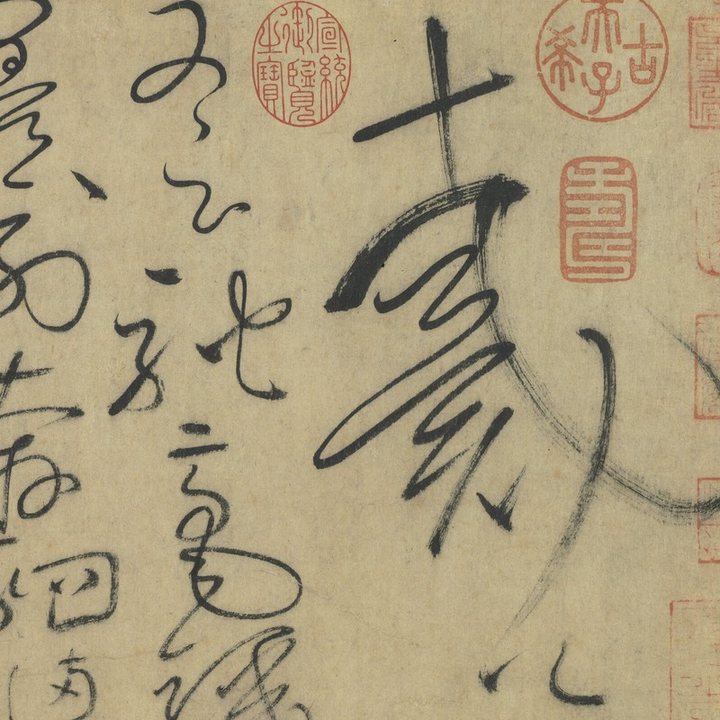
唐懷素自敘帖 卷。國立故宮博物院,台北,CC BY 4.0 @ www.npm.gov.tw(經裁切、拼接)The Cold Food Observance · Su Shi (Song dynasty)〈寒食帖〉・蘇軾(宋)
Running script; poems of 1082. Heavy, slanting running script that grows bigger, with a few strokes pulled very long. 行書;詩作於元豐五年(1082)。又重又斜的行書,越寫越大,有幾個字的長筆畫拉得很長。
北宋蘇東坡書黃州寒食詩 卷。國立故宮博物院,台北,CC BY 4.0 @ www.npm.gov.tw(經裁切、拼接)
Practice Pad · 練字板
One more time: three scripts 再寫一次:三種字體
Three of the five treasures are in running script and two are in cursive. Trace 永, 之, and 水 once more in all three scripts, and time yourself. These models are from Lesson 7. 五件國寶裡有三件是行書、兩件是草書。再用三種字體描一次「永、之、水」,順便計時。這些範字是第七課的。
Script · 字體
Character · 範字
Thin · 細Thick · 粗
Mouse or finger: slow = thick, fast = thin滑鼠或手指:寫得慢=粗、寫得快=細Stylus: press harder for a thicker line觸控筆:越用力線越粗
Start with running script, the script of three of the five works.先寫行書——五件作品裡有三件是行書。
Then try cursive: fewer lifts, and the strokes melt into each other.再試草書:提筆更少,筆畫融在一起。
Go back to regular script last. Does it feel different now?最後回到楷書。現在寫起來,感覺有沒有不一樣?
Stopwatch · 碼表
From your first touch to your last lift. · 從第一筆下筆算到最後一筆提筆。
Stories and a Visit · 故事與參觀
A scroll that survived fire, ten thousand banana plants, an emperor's favorite, and how to visit 逃過火災的卷子、一萬多株芭蕉、皇帝的最愛,和參觀須知
Three stories that are written on the scrolls themselves or in old books, and what to know before you go. 三個寫在卷子上或古書裡的故事,還有出發前要知道的事。
A Journey · 流傳
The scroll that survived fire逃過火災的〈寒食帖〉
Later owners wrote the scroll's story on the scroll itself. One note says it was marked by fire when the Summer Palace was burned in 1860. It later went to Japan, where its owner carried it out of the fires after the great Tokyo earthquake of 1923. After the Second World War it was bought back, and in 1987 the museum bought it. 後來的收藏者把這卷字的遭遇寫在卷子後面。一則題跋說,1860 年圓明園被焚時它留下了燒痕。後來它流落到日本;1923 年關東大地震引起大火,收藏者冒險把它搶救出來。第二次世界大戰後它被買回,1987 年由故宮收購。
Practice · 苦練
Ten thousand banana plants懷素種芭蕉
A Tang dynasty life of Huaisu says he was too poor to buy paper, so he planted more than ten thousand banana plants at home to write on. When that was not enough, he wrote on a lacquered tray and a lacquered board, over and over, until he wore them through. 唐朝陸羽寫的〈僧懷素傳〉說:懷素「貧無紙可書,嘗於故里種芭蕉萬餘株,以供揮灑。書不足,乃漆一盤書之,又漆一方板,書至再三,盤板皆穿。」——沒有紙,就種芭蕉來寫;還不夠,就寫在漆盤和漆板上,寫到都磨穿了。
An Emperor · 皇帝
The emperor's favorite乾隆最愛的一封信
The Qianlong Emperor treasured Wang Xizhi's snow letter. The museum notes that he praised it as “matchless under heaven, rarely equaled in any age,” and kept it with two other works as his “Three Rarities.” You can still see his writing and seals all around the four lines. 乾隆皇帝非常珍愛〈快雪時晴帖〉。故宮說他「譽之為『天下無雙,古今鮮對』」,並把它和另外兩件作品合稱「三希」。直到今天,那四行字的周圍還看得到他題的字和蓋的印章。
Taiwan · 台灣
Before you visit去故宮之前
The museum is at No. 221, Section 2, Zhishan Road, Shilin District, Taipei. These works are not always on show, so check the museum's website first. Flash, extra lights, tripods, and selfie sticks are not allowed. The galleries are kept at 20 to 24 degrees Celsius, so bring a jacket. 故宮在臺北市士林區至善路二段 221 號。這些作品不是隨時都在展出,出發前先上故宮的網站查。展場拍照「禁止使用閃光燈、補光器材、腳架、自拍器」。展廳溫度維持在攝氏 20 到 24 度,記得帶件外套。
Myth vs. Fact · 常見迷思
Four things people get wrong 四個常見的誤會
✗ Myth · 迷思The museum's most famous works are always on show.故宮最有名的作品隨時都看得到。
✓ Fact · 事實Most paintings and calligraphy are shown for no more than three months and then rest for at least eighteen months. The seventy most protected works are shown for no more than 42 days at a time.一般書畫「展出期間以不超過三個月為原則,每次展出後須歸庫養護至少十八個月」;七十件限展書畫精華,一次最多展 42 天。
✗ Myth · 迷思Timely Clearing After Snowfall is in Wang Xizhi's own hand.〈快雪時晴帖〉是王羲之親筆寫的。
✓ Fact · 事實The museum describes it as a fine tracing copy made in the Tang dynasty. As Lesson 8 told, the original of his Lanting Xu is lost too.故宮的說明是「本幅為唐代精摹本」。第八課說過,他的〈蘭亭序〉原蹟也已經失傳。
✗ Myth · 迷思Ancient critics ranked the Cold Food scroll “the third-best running script under heaven.”古人把〈寒食帖〉評為「天下第三行書」。
✓ Fact · 事實We could not find any old source for that ranking. What the records do have is the Ming dynasty artist Dong Qichang, who called it the best of Su Shi's writing. Grouping it with the Lanting Xu and Yan Zhenqing's draft as the three great works of running script is a later habit.這個排名找不到古人的出處。有記錄的是明朝董其昌稱它為「蘇書甲觀」。把它和〈蘭亭序〉、〈祭姪文稿〉合稱三大行書,是後人的說法。
✗ Myth · 迷思The lights are low because black ink fades quickly.燈光暗,是因為黑色的墨很容易褪色。
✓ Fact · 事實Carbon ink is one of the materials least harmed by light. What light harms more are the paper, the silk, and their colors. That is why our test strip in the model uses dyes, not ink.碳做的墨是最不怕光的材料之一。比較怕光的是紙、絹和上面的顏色。所以模型裡的試紙用的是染料,不是墨。
Light × time: the harm cannot be undone. 照度 × 時間:傷害無法復原。
Dim, short, and rest燈暗、展短、要休息
50 lux; 42 days; three years of rest. 50 lux;42 天;休息三年。
No flash不開閃光燈
Walk slowly and look closely. 慢慢走,仔細看。
In the Classroom · 教室提醒
Before you pick up a brush 拿起毛筆之前
Ink stains clothes and is very hard to wash out. Wear old clothes or an apron, and roll up your sleeves.墨沾到衣服很難洗掉:穿舊衣服或圍裙,袖子捲起來。
Cover the desk with old newspaper, and keep the ink in a heavy, steady dish so it will not tip over.桌上先鋪舊報紙;墨要裝在重一點、放得穩的碟子裡,免得打翻。
Press gently. Crushing the brush against the paper squashes the hairs and can split or break them.輕輕地按就好:把筆用力壓在紙上,筆毛會擠扁,也可能分岔或折斷。
Do not put the brush, the ink, or the ink stick in your mouth, and do not lick the brush tip to shape it.毛筆、墨汁、墨條都不要放進嘴裡,也不要用嘴巴舔筆尖。
After writing, wash the brush in clean water until the water runs clear, gently shape it into a point, and hang it tip-down or lay it flat to dry. Wash your hands, too.寫完後用清水洗筆,洗到水變清為止;輕輕把筆毛理成尖形,筆尖朝下掛起來或平放晾乾。也要洗手。
Classroom Activity 1 · 課堂活動一
The Sunlight Test 陽光實驗
You need · 準備材料
Two sheets of colored construction paper (the same color)兩張同樣顏色的色紙
A piece of thick card and some tape一塊厚紙板和膠帶
A sunny windowsill and a drawer曬得到太陽的窗台,和一個抽屜
Steps · 步驟
Tape the card over half of one sheet and put it on the sunny windowsill.用厚紙板蓋住其中一張色紙的一半,放在窗台上曬太陽。
Put the other sheet in a dark drawer.另一張放進黑暗的抽屜。
After two weeks, take off the card and compare the three: sunlit, covered, and drawer.兩個星期後拿掉紙板,比較三個地方:曬到太陽的、被蓋住的、抽屜裡的。
Talk about it: which museum rules does this explain?討論:這個實驗可以解釋博物館的哪些規定?
Take a photo on the first day so you can compare. 第一天先拍一張照片,之後才好比較。
Classroom Activity 2 · 課堂活動二
Be a Curator 我是策展人
You need · 準備材料
This page's five works, on a screen or printed這一頁的五件作品(用螢幕看或印出來)
Cards and pens for labels寫說明牌的卡片和筆
Steps · 步驟
Each group chooses one of the five works.每組從五件作品裡選一件。
Write a museum label in English: who, when, which script, and one sentence about why it is special.用英文寫一張說明牌:誰寫的、什麼時候、哪一種字體,再用一句話說它特別的地方。
Decide how long your work may be on show, and how you will protect it from light.決定你的作品可以展多久,以及要怎麼保護它不被光傷害。
Hold a five-work exhibition and give a one-minute tour.辦一場五件作品的小展覽,每組導覽一分鐘。
Good labels are short. Try to use fewer than forty words. 好的說明牌很短。試試看不超過四十個英文字。
Ten Lessons · 十堂課
Look how far you have come 回頭看看,你走了多遠
This is the last lesson of the first ten. Here they are, with one sentence each. Tap any lesson to go back. 這是前十課的最後一課。十堂課各用一句話回顧,點任何一課都可以回去看。
Dates, names, places, and facts on this page were checked against these sources (October 2026). · 本頁的年代、人名、地名與事實依下列資料查證(2026 年 10 月)。
Museum history: founded October 10, 1925; treasures moved south in 1933 (13,427 crates and 64 bundles); shipped to Taiwan in 1948–49; the new Taipei building opened on November 12, 1965院史:「1925年10月10日,故宮博物院正式成立」;1933 年「故宮文物共13,427箱又64包,計分五批啟運」;1948 年秋「主張擇精品運臺」;1965 年「11月12日,國立故宮博物院臺北新館落成揭幕」國立故宮博物院〈院史〉 ↗
Collection: 3,757 works of calligraphy (as of September 30, 2026)典藏統計:「法書-3,757件」(截至 115 年 9 月 30 日)國立故宮博物院〈典藏概述〉 ↗
Light limits: paintings and calligraphy no more than 50 lux; restricted works no more than 16,000 lux-hours a year (for example, 50 lux, 8 hours a day, 40 days); UV below 75 microwatts per lumen「書畫、紙、絹…不高於50 Lux」「限展書畫之年累積照度不高於16,000Lux.h/year為原則」「例如50Lux,每天8小時,可展40天」「紫外線強度低於七十五微瓦/流明」〈國立故宮博物院文物展覽保存維護要點〉 ↗
Most paintings and calligraphy: shown for no more than three months, then at least eighteen months in storage「展出期間以不超過三個月為原則,每次展出後須歸庫養護至少十八個月。」國立故宮博物院主管法規共用系統 ↗
The seventy restricted works: no more than 42 days on show「若屬『七十件限展書畫精華』,展期則以42天為上限。」國立故宮博物院展覽說明 ↗
At least three years between showings, and no more than 42 days「為了加強保護珍貴古物,減少被光線照射的時間,每次展覽至少必須間隔三年以上,而且展期不能超過 42 天。」國立故宮博物院展覽說明 ↗
Timely Clearing After Snowfall: museum record (故書000141)〈晉王羲之快雪時晴帖 冊〉典藏頁(故書000141):作者、書體、年代、尺寸與說明國立故宮博物院典藏資料檢索 ↗
Treatise on Calligraphy: museum record (故書000058)〈唐孫過庭書譜 卷〉典藏頁(故書000058):作者、書體、年代、尺寸與說明國立故宮博物院典藏資料檢索 ↗
Draft of a Requiem to My Nephew: museum record (故書000060)〈唐顏真卿祭姪文稿 卷〉典藏頁(故書000060):作者、書體、年代、尺寸與說明國立故宮博物院典藏資料檢索 ↗
Autobiography: museum record (故書000062)〈唐懷素自敘帖 卷〉典藏頁(故書000062):作者、書體、年代、尺寸與說明國立故宮博物院典藏資料檢索 ↗
The Cold Food Observance: museum record (購書001001)〈北宋蘇東坡書黃州寒食詩 卷〉典藏頁(購書001001):作者、書體、年代、尺寸與說明國立故宮博物院典藏資料檢索 ↗
All five were designated National Treasures on March 26, 2012 (this link: the Cold Food scroll, with its history: about 1949 to a Taipei collector; bought by the museum in 1987)五件都在 2012-03-26 指定為國寶(此連結:寒食帖,含流傳經過「約一九四九年歸台北收藏家,一九八七年故宮購回」與「蘇書甲觀」)文化部文化資產局國家文化資產網 ↗
Su Shi: sent to Huangzhou; built a house on the Eastern Slope and called himself Dongpo「以黃州團練副使安置。軾與田父野老,相從溪山間,築室於東坡,自號『東坡居士』。」維基文庫《宋史》卷三百三十八 ↗
Cold Food Festival: one or two days before Qingming, when no fires were lit寒食節:「每年冬至後一百零五日,約在清明節前一、二日」「禁火寒食」教育部《重編國語辭典修訂本》「寒食節」 ↗
Huaisu planted more than ten thousand banana plants to write on「貧無紙可書,嘗於故里種芭蕉萬餘株,以供揮灑。」維基文庫 陸羽〈僧懷素傳〉 ↗
Wild cursive: flourished in the Tang dynasty with Zhang Xu and Huaisu狂草:「至唐代張旭、懷素時盛行。狂草筆勢縱逸不拘,連綿迴繞」教育部《重編國語辭典修訂本》「狂草」 ↗
Visiting rules: no flash, extra lights, tripods, or selfie sticks; galleries kept at 20–24°C「展場拍照或攝影禁止使用閃光燈、補光器材、腳架、自拍器等輔助設備」「展廳溫度維持在攝氏20度至24度間」國立故宮博物院〈展場參觀須知〉 ↗
Taiwan curriculum: know stories of famous calligraphers (4-Ⅱ-8); appreciate famous works (4-Ⅳ-4)十二年國教國語文領綱:4-Ⅱ-8「知道古今書法名家的故事。」4-Ⅳ-4「認識各種書體,欣賞名家碑帖。」國家教育研究院《十二年國民基本教育課程綱要 語文領域—國語文》 ↗