
Regular script楷書
Five strokes, and every one has its own careful start and finish. Between strokes, the brush leaves the paper four times.
五筆,每一筆都有自己的起筆和收筆。筆和筆之間,毛筆離開紙四次。
Chinese Calligraphy · Unit 2 · Lesson 7 · 書法 單元二 第七課
One character, three ways to write it. In regular script every stroke stands alone. In running script the strokes join. In cursive script they melt into one flowing line. Watch three brushes race in 3D, name five scripts in a game, and time your own writing on the practice pad.
同一個字,三種寫法:楷書一筆一畫分開,行書把筆畫連起來,草書連成一條流動的線。看三枝毛筆在 3D 裡比賽,玩五種字體的認字遊戲,再用練字板的碼表量量自己寫多快。
Regular, running, and cursive script are three ways to write the same character. Regular script writes each stroke separately, so it is the clearest and the slowest. Running script links the strokes, so it is quicker and still easy to read. Cursive script joins and simplifies the strokes, so it is the fastest and the hardest to read.
楷書、行書、草書,是同一個字的三種寫法。楷書一筆一畫分開寫,最清楚、也最慢;行書把筆畫連起來,比較快、還認得出來;草書把筆畫連在一起又簡化,最快、也最難認。
3D Model · 3D 模型
Drag to turn, and scroll or pinch to zoom. Three brushes write the same character at the same time: regular script on the left, running script in the middle, and cursive script on the right. Watch the timers, then choose one script to look closer, or change the character.
拖曳可以旋轉,滾輪或雙指可以縮放。三枝毛筆同時寫同一個字:左邊楷書、中間行書、右邊草書。看看每張紙上的計時,再選一種字體近看,或換一個字。
Drag to turn · 拖曳旋轉 Scroll or pinch to zoom · 滾輪/雙指縮放
This 3D model needs WebGL, which this browser does not support. The reading, the cards, the game, and the practice pad below still work.
這個瀏覽器不支援 WebGL,無法顯示 3D 模型;下方的課文、卡片、小遊戲和練字板一樣能用。
A teaching model. The times are calculated by our model, not measured from a real calligrapher: the brush takes time for the careful start and finish of every stroke, and each lift between strokes costs 0.82 seconds. The running and cursive forms are our own tracings over an early copy of the Lanting Xu and a rubbing of Zhiyong's Thousand Character Classic.
這是教學用的示意模型。時間是模型算出來的,不是量真人寫字:每一筆仔細的起筆和收筆都要花時間,筆和筆之間每提筆一次算 0.82 秒。行書和草書的字形,是我們對著〈蘭亭序〉的古摹本和智永〈真草千字文〉的拓本自己描的。
Model, stroke data, and the writing engine are drawn and programmed by My Culture Connect. Running-script reference: the Shenlong copy of the Lanting Xu (Wikimedia Commons, public domain). Cursive-script reference: 墨拓智永書真草千文 冊, The National Palace Museum, Taipei, CC BY 4.0 @ www.npm.gov.tw. · 模型、筆畫資料與寫字引擎由人師教育協會自繪、自寫;行書對位參考神龍本〈蘭亭序〉(維基共享資源,公有領域),草書對位參考國立故宮博物院〈墨拓智永書真草千文 冊〉(CC BY 4.0)。
Reading · 英文閱讀
Write your name slowly and neatly. Now write it again as fast as you can. The letters lean, join, and lose some of their parts. Chinese calligraphy has names for these different ways of writing. Three of them are regular script, running script, and cursive script.
In regular script, every stroke is written separately. The brush starts each stroke with care, finishes it with care, and then leaves the paper before the next one. This makes regular script the clearest of the three, and the slowest. It is the form you see in textbooks and learn first.
Running script sits between regular and cursive script. The Ministry of Education's dictionary says it is close to regular script but more flowing and lively. The brush does not always leave the paper, so some strokes are joined by a thin line called a thread. The characters are quicker to write and still easy to recognize.
Cursive script was made for speed. The same dictionary says it appeared so that people could write conveniently and quickly. Strokes are joined, shortened, or left out, so a whole character can become one or two flowing lines. It is the fastest of the three, and the hardest to read.
Here is a surprise: cursive script is not regular script written in a hurry. It began around the Qin and Han dynasties as a quick way to write clerical script. Regular script took shape later, in the Later Han dynasty, and was complete by the Wei. So the three scripts are three ways of writing, and all three are still used today.
In this lesson, three brushes write the same character at the same time, and you can see which one finishes first. Then name all five scripts you have met in this unit, and use the stopwatch on the practice pad to find your own three speeds.
Questions · 閱讀理解
Which of the three scripts is the clearest, and which is the fastest?
What is a thread in running script?
Did cursive script come from writing regular script quickly? What does the lesson say?
Words & Phrases · 生字及片語
Quick Check · 小測驗
1. In which script is every stroke written separately?
2. What joins two strokes in running script?
3. Why was cursive script made?
4. Which script is usually the hardest to read?
5. In the old saying, regular script is like standing and running script is like walking. What is cursive script like?
Three Scripts · 三種字體
The numbers come from our model of the character 永. Tap Watch it in 3D to see each script written by itself.
卡片上的數字是用我們的模型算「永」字得到的。點「在模型中看」,單獨看每一種字體怎麼寫。
Five strokes, and every one has its own careful start and finish. Between strokes, the brush leaves the paper four times.
五筆,每一筆都有自己的起筆和收筆。筆和筆之間,毛筆離開紙四次。
Four strokes: the left-falling stroke runs straight into the right-falling stroke. The red lines are threads, where the brush hardly leaves the paper. Traced from an early copy of the Lanting Xu.
四筆:撇直接連到捺。紅色的細線是牽絲,毛筆在那裡幾乎沒有離開紙。字形描自〈蘭亭序〉的古摹本(神龍本)。
One line. The dot, the hook, and both sides are joined and simplified into a single looping stroke. Traced from a rubbing of Zhiyong's Thousand Character Classic.
一筆到底。點、鉤和左右兩邊連在一起、又簡化了,變成一條繞圈的線。字形描自智永〈真草千字文〉的拓本。
From the Masters · 法帖裡的字
Our running and cursive characters are tracings. Here are the works we traced them from.
模型裡的行書和草書是我們描的。這裡是我們照著描的法帖。
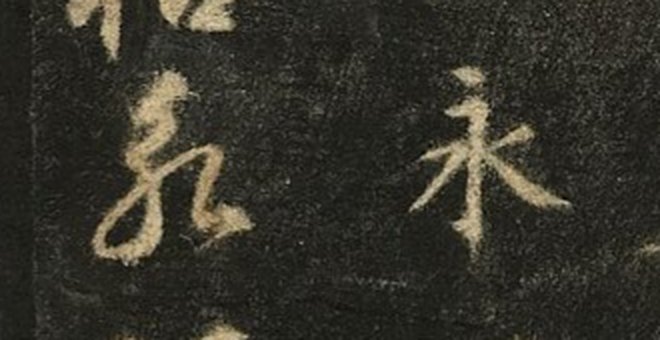
Zhiyong, a monk and a descendant of Wang Xizhi, wrote the Thousand Character Classic in regular and cursive script side by side, which helps learners recognize the cursive forms. Here the regular 永 is on the right and the cursive 永 on the left. This rubbing was made from a stone carved in 1109.
智永是王羲之的後代,也是一位出家人。他把〈千字文〉用楷書和草書並排寫出來,方便學的人認草書。圖中右邊是楷書的「永」,左邊是草書的「永」。這份拓本拓自大觀三年(1109)刻的石碑。
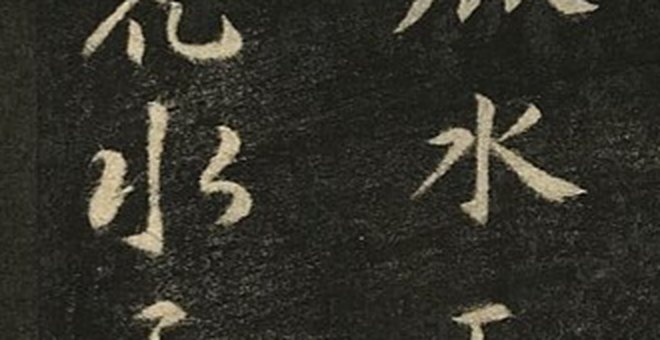
From the same rubbing: the regular 水 on the right has four strokes. In the cursive 水 on the left, they have become three short curves.
同一份拓本:右邊楷書的「水」有四筆;左邊草書的「水」,變成三條短短的彎線。
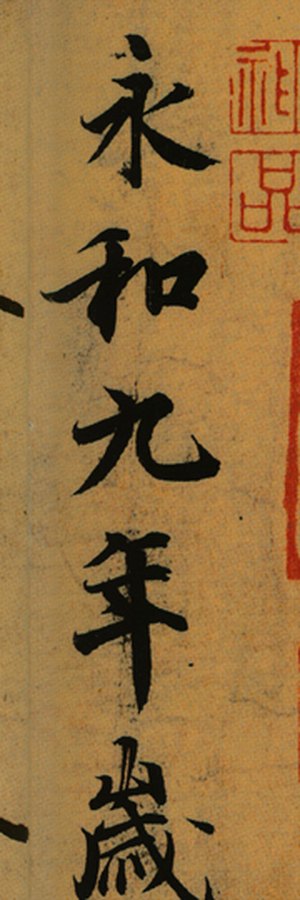
The first four characters of the Lanting Xu: 永和九年, the ninth year of Yonghe (353). Wang Xizhi's original is lost. This is from an early tracing copy known as the Shenlong copy. Our running-script 永 was traced from the first character.
〈蘭亭序〉開頭四個字「永和九年」(353)。王羲之的原蹟已經失傳,這是一件古摹本(神龍本)。我們行書的「永」,就是照著第一個字描的。
Game · 小遊戲
You have now met five scripts: seal, clerical, regular, running, and cursive. Look at each character and name its script. Ten questions make a round.
到這一課,你已經認識五種字體:篆書、隸書、楷書、行書、草書。看看每個字,說出它是哪一種字體。一輪十題。
Right on the first try一次就答對0 / 10
Practice Pad · 練字板
Choose a script and a character, then trace it. The stopwatch runs from your first touch to your last lift, and it counts how many times you lift.
選一種字體、一個字,描寫看看。碼表從你第一筆下筆算到最後一筆提筆,也會數你提筆幾次。
Mouse or finger: slow = thick, fast = thin滑鼠或手指:寫得慢=粗、寫得快=細Stylus: press harder for a thicker line觸控筆:越用力線越粗
Stopwatch · 碼表
From your first touch to your last lift. · 從第一筆下筆算到最後一筆提筆。
Stories of Three Scripts · 三種字體的故事
Four short stories about writing slowly, writing quickly, and learning to do both.
關於慢慢寫、快快寫,還有兩種都要學的四個小故事。
An Old Saying · 老話
The Song dynasty writer Su Shi put it this way: regular script is like standing, running script is like walking, and cursive script is like running, and nobody can run before learning to stand and walk. (English says running script, but 行 means to walk.) In Taiwan, elementary school students practice regular script, and in junior high they learn to recognize the different scripts.
宋代的蘇軾說:「真如立,行如行,草如走,未有未能行立而能走者也。」楷書像站著,行書像走路,草書像跑步(古文的「走」是跑);還不會站、不會走的人,不可能會跑。在台灣,國小學生練寫楷書,到國中「認識各種書體」。
A Model Book · 範本
Zhiyong was a monk and a seventh-generation descendant of Wang Xizhi. He is said to have written 800 copies of the Thousand Character Classic, each in regular and cursive script, and given them to temples. Putting the two scripts side by side helps learners recognize the cursive forms. The National Palace Museum in Taipei has a rubbing of a version carved in stone in 1109; the pictures above come from it.
智永是一位出家人,也是王羲之的七世孫。據記載,他臨寫了八百本〈真草千字文〉,每一本都用楷書和草書並列,分送給各寺院。兩種字體並排,方便學的人認草書。台北國立故宮博物院藏有大觀三年(1109)刻石的拓本,上面的圖片就是從那裡來的。
Running Script · 行書
In 353, Wang Xizhi and his friends met at the Orchid Pavilion to write poems, and he wrote the preface to their poems: the Lanting Xu. It has long been called the best running script under heaven. The original is lost, and we know it only from copies. Our running-script 永 was traced from the first character of one early tracing copy, known as the Shenlong copy. Lesson 8 tells the story.
東晉永和九年(353),王羲之和謝安等四十一人在蘭亭聚會作詩,他為詩集寫了序,就是〈蘭亭序〉,素有「天下第一行書」之稱。原蹟已經失傳,今天只能看到摹本。我們行書的「永」,就是照著一件古摹本(神龍本)的第一個字描的。第八課會說這個故事。
Taiwan · 台灣
Two famous cursive scrolls are in the National Palace Museum in Taipei, and both are National Treasures. Sun Guoting wrote his Treatise on Calligraphy (書譜) in 687. The monk Huaisu wrote his Autobiography (自敘帖) in 777 in wild cursive, the freest kind, with many simplified and joined strokes.
兩件有名的草書長卷都在台北國立故宮博物院,都是國寶。孫過庭的〈書譜〉寫於垂拱三年(687)。出家人懷素的〈自敘帖〉寫於大曆十二年(777),用的是狂草——最奔放的一種草書,簡筆、連筆很多。
Myth vs. Fact · 常見迷思
✗ Myth · 迷思Cursive script is just messy writing.草書就是亂寫。
✓ Fact · 事實Cursive script has its own forms to learn. Zhiyong wrote a whole model book with every line in regular script and again in cursive, and the Ministry of Education's dictionary calls it an excellent model for learning both.草書有自己的寫法要學。智永寫了一整本範本,每一行都有楷書和草書;教育部辭典說它是「學習楷書與草書的絕佳範本」。
✗ Myth · 迷思Cursive script came from writing regular script faster.草書是把楷書寫快變來的。
✓ Fact · 事實It is the other way around in time. Cursive script began around the Qin and Han dynasties as a quick form of clerical script. Regular script took shape in the Later Han and was complete by the Wei.時間上正好相反。草書大約起於秦漢之際,是隸書的快寫;楷書約起源於後漢,到魏才完備。
✗ Myth · 迷思In cursive script, the brush never leaves the paper.寫草書,毛筆從頭到尾都不離開紙。
✓ Fact · 事實Sometimes it does. In our tracing of Zhiyong's cursive 水, there are three separate strokes. Early cursive script even kept every character apart from the next one.有時候還是會離開。我們描的智永草書「水」就有三筆。早期的草書(章草)甚至每個字都各自獨立,不和下一個字相連。
✗ Myth · 迷思草書 means “grass writing.”「草書」的「草」是青草的草。
✓ Fact · 事實The character 草 can mean grass, but it also means rough or quick, as in 潦草 (careless writing) and 草稿 (a draft). The dictionary describes early cursive script as clerical script written quickly and roughly.「草」可以是青草,但也有「草率、粗略」和「草稿」的意思,像「潦草」「起草」。教育部辭典說,早期的草書是「將隸書草率寫成」。
Remember It · 記憶口訣
Regular script stands, running script walks, and cursive script runs.
楷書像站著,行書像走路,草書像跑步。
Every stroke starts and finishes by itself.
每一筆都自己起筆、收筆。
A thin line leads the brush to the next stroke.
細細的線把筆帶到下一筆。
Strokes join, shrink, or disappear.
筆畫連起來、縮短,或省略。
In the Classroom · 教室提醒
Classroom Activity 1 · 課堂活動一
You need · 準備材料
Steps · 步驟
Ask: when would you choose the slow way? When would the fast way be good enough?
問問大家:什麼時候要選慢的寫法?什麼時候快的寫法就夠了?
Classroom Activity 2 · 課堂活動二
You need · 準備材料
Steps · 步驟
This links back to Lesson 4: a shared standard lets people read one another's writing.
這和第四課有關:有共同的標準,大家才看得懂彼此寫的字。
Before and Next · 上一課與下一課
Sources · 資料出處
Dates, names, places, and facts on this page were checked against these sources (October 2026). · 本頁的年代、人名、地名與事實依下列資料查證(2026 年 10 月)。