
Yan Zhenqing: muscle顏真卿:筋
Thick, full lines. The right-falling stroke swells into a heavy foot. The dictionary describes his writing as powerful, grand, and dignified.
線條又粗又飽滿,捺的末端有厚重的捺腳。教育部辭典形容他的字「筆力勁拔,雄渾莊重」。
Chinese Calligraphy · Unit 3 · Lesson 9 · 書法 單元三 第九課
Yan Zhenqing and Liu Gongquan both wrote regular script in the Tang dynasty, yet you can tell them apart at a glance. Watch two brushes write the same character side by side in 3D, compare their press-and-lift curves, guess who wrote each character on real stone rubbings, and find out whose lines yours are closer to.
顏真卿和柳公權都是唐朝人,寫的都是楷書,可是一眼就分得出來。在 3D 裡看兩枝毛筆並排寫同一個字、比一比提按曲線,到真的拓本上猜猜每個字是誰寫的,再看看你的線條比較像誰。
Every calligrapher writes the same characters with the same strokes, but each one presses, lifts, and shapes them in a different way. Yan Zhenqing's lines are thick and full; Liu Gongquan's are lean and firm. Later writers summed it up in four characters: 顏筋柳骨, the muscle of Yan and the bone of Liu.
每一位書法家寫的是同樣的字、同樣的筆畫,可是下筆的輕重、提按的方式、字的形狀,每個人都不一樣。顏真卿的線條又粗又飽滿,柳公權的線條又瘦又挺。後人用四個字來形容:「顏筋柳骨」。
3D Model · 3D 模型
Drag to turn, and scroll or pinch to zoom. Two brushes write the same character at the same time: Yan Zhenqing's way on the left, Liu Gongquan's way on the right. Choose a character, replay one stroke at a time, and compare the two press-and-lift curves.
拖曳可以旋轉,滾輪或雙指可以縮放。兩枝毛筆同時寫同一個字:左邊是顏真卿的寫法,右邊是柳公權的寫法。可以換字、一筆一筆重播,再比一比兩條提按曲線。
Drag to turn · 拖曳旋轉 Scroll or pinch to zoom · 滾輪/雙指縮放
This 3D model needs WebGL, which this browser does not support. The reading, the cards, the game, and the practice pad below still work.
這個瀏覽器不支援 WebGL,無法顯示 3D 模型;下方的課文、卡片、小遊戲和練字板一樣能用。
A teaching model. Both characters are drawn at the same size so that the lines can be compared, and the brushes move by the same speed rules. The center lines are our own tracings over rubbings of the Duobao Pagoda Stele (Yan, 752) and the Xuanmi Pagoda Stele (Liu, 841); the thickness of each line is measured from those rubbings. The widths in the table are for a 25-cm square, and they count only the main part of each stroke. A stone carving and its rubbing are not exactly what the brush wrote, so the numbers are a guide, not a measurement of the original writing.
這是教學用的示意模型。兩個字放大到同樣大,線條才能比較;兩枝筆照同一套速度規則移動。中心線是我們對著〈多寶塔碑〉(顏,752 年)和〈玄秘塔碑〉(柳,841 年)的拓本自己描的,每一點的粗細是從拓本上量出來的。表格裡的寬度是字寫在 25 公分方格裡的大小,只算每一筆中間的行筆。刻在石頭上再拓下來的字,和毛筆當初寫的不會完全一樣,所以這些數字只是參考,不是原蹟的測量值。
Model, stroke data, and the writing engine are drawn and programmed by My Culture Connect. The two forms of each character are our own tracings over public-domain rubbings: Yan Zhenqing, Duobao Pagoda Stele (Wikimedia Commons; Tokyo National Museum) and Liu Gongquan, Xuanmi Pagoda Stele (Wikimedia Commons). · 模型、筆畫資料與寫字引擎由人師教育協會自繪、自寫;每個字的兩種寫法,是對著公有領域的拓本自己描的:顏真卿〈多寶塔碑〉(維基共享資源;東京國立博物館藏)、柳公權〈玄秘塔碑〉(維基共享資源)。
Reading · 英文閱讀
Ask two friends to write the character 大. They will use the same three strokes in the same order, but the two characters will not look the same. Calligraphers are like that too. Two of the most famous, Yan Zhenqing and Liu Gongquan, both lived in the Tang dynasty and both wrote regular script, yet people can tell their writing apart at a glance.
Yan Zhenqing was an official in the 700s. His lines are thick and full, and his characters look broad and steady. He was also known for his courage. When the general An Lushan rebelled, most cities in the north fell, but Yan had quietly repaired the walls of his city, Pingyuan, and stored food, so it was ready. In his seventies he was sent to speak with another rebel, who killed him because he would not give in.
Liu Gongquan was born about seventy years later. His lines are leaner, with sharp corners and a tight center, like a strong, thin frame. One day the emperor asked him how to use the brush well. Liu answered, “Using the brush depends on the heart. When the heart is upright, the brush is upright.” The emperor understood that Liu was really giving him advice about how to rule.
Almost two hundred years after Liu died, the Song dynasty writer Fan Zhongyan praised a friend's calligraphy with four characters: 顏筋柳骨, “the muscle of Yan and the bone of Liu.” The words stuck. Muscle stands for Yan's full, powerful lines; bone stands for Liu's hard, clean ones. Both are praise: the phrase means writing that is strong.
Where does the difference come from? Not from the characters, and not from the stroke order. It comes from how hard the brush presses, where it lifts, how each stroke begins and ends, and how the strokes are spaced. In our model, when both write the same character at the same size, Yan's lines are 1.2 to 1.5 times as thick as Liu's.
For more than a thousand years, students have learned regular script by copying masters such as these two, stroke by stroke. People often name four great masters of regular script together: Ouyang Xun, Yan Zhenqing, Liu Gongquan, and Zhao Mengfu. In this lesson, watch two brushes write side by side, guess who wrote each character, and then try both styles yourself.
Questions · 閱讀理解
How are Yan Zhenqing's lines different from Liu Gongquan's?
What did Liu Gongquan tell the emperor about using the brush?
If the characters and the stroke order are the same, where does the difference between two calligraphers come from?
Words & Phrases · 生字及片語
Quick Check · 小測驗
1. In which dynasty did Yan Zhenqing and Liu Gongquan live?
2. Whose lines are thick and full?
3. What does 顏筋柳骨 mean?
4. What did Liu Gongquan say makes the brush upright?
5. Two calligraphers write the same character. What can be different?
Two Masters · 兩位書法家
These two 大 are our own tracings over the rubbings. Tap Watch it in 3D to see each one written.
這兩個「大」是我們對著拓本描的。點「在模型中看」,看毛筆怎麼寫出來。
Thick, full lines. The right-falling stroke swells into a heavy foot. The dictionary describes his writing as powerful, grand, and dignified.
線條又粗又飽滿,捺的末端有厚重的捺腳。教育部辭典形容他的字「筆力勁拔,雄渾莊重」。
Leaner lines with sharp corners, and the strokes pull in tightly toward the center. The dictionary describes his writing as strong in bone and tight in structure.
線條比較瘦,轉角銳利,筆畫往字的中心收緊。教育部辭典形容他的字「骨力遒健,結構緊密」。
On the Stone · 碑帖上的字
Each row is one character written by four masters of regular script. Look across a row: which is the thickest? Which has the sharpest corners? Three are rubbings from stone (white on black); Zhao Mengfu's is ink on paper.
每一列是同一個字,由四位楷書名家寫的。橫著看一列:誰最粗?誰的轉角最銳利?前三位是從石碑拓下來的(黑底白字),趙孟頫的是寫在紙上的墨跡。
| 歐陽詢Ouyang Xun〈九成宮醴泉銘〉 | 顏真卿Yan Zhenqing〈多寶塔碑〉 | 柳公權Liu Gongquan〈玄秘塔碑〉 | 趙孟頫Zhao Mengfu〈膽巴碑〉 | |
|---|---|---|---|---|
| 大big | 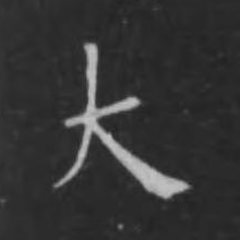 | 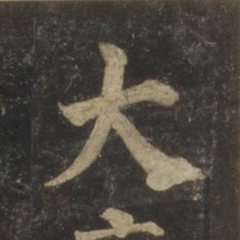 | 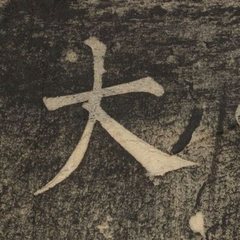 | 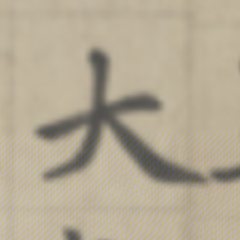 |
| 之of | 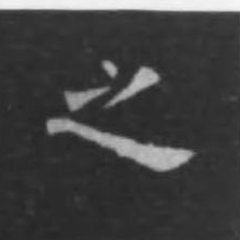 | 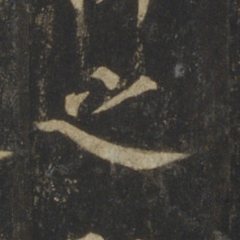 | 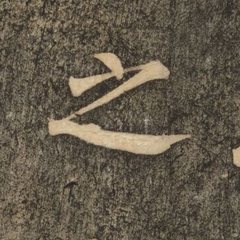 | 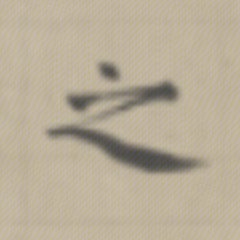 |
| 無without | 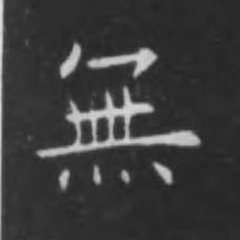 | 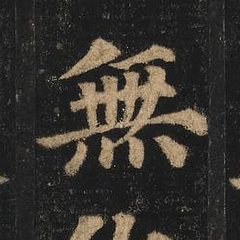 | 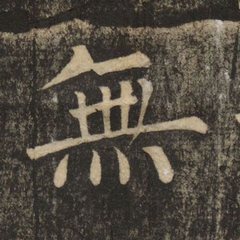 | 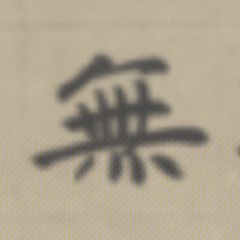 |
| 以by | 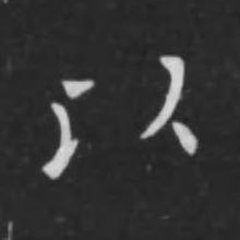 | 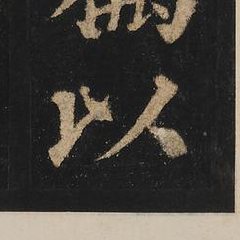 | 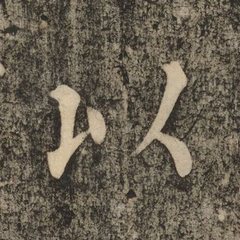 | 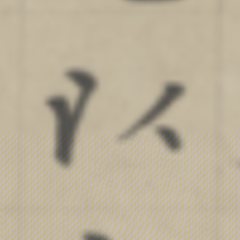 |
Ouyang Xun, Jiucheng Palace inscription, reproduction of a Tang rubbing, National Diet Library, Japan (Wikimedia Commons, public domain); Yan Zhenqing, Duobao Pagoda Stele, Northern Song rubbing, Tokyo National Museum (Wikimedia Commons, public domain); Liu Gongquan, Xuanmi Pagoda Stele rubbing (Wikimedia Commons, public domain); Zhao Mengfu, Danba Stele handscroll, Palace Museum, Beijing (Wikimedia Commons, public domain). · 歐陽詢〈九成宮醴泉銘〉唐拓本複製本,日本國立國會圖書館藏;顏真卿〈多寶塔碑〉北宋拓本,東京國立博物館藏;柳公權〈玄秘塔碑〉拓本;趙孟頫〈帝師膽巴碑〉卷,北京故宮博物院藏(皆取自維基共享資源,公有領域)。
Game · 小遊戲
Each character is cut from a real rubbing: the Duobao Pagoda Stele by Yan Zhenqing, or the Xuanmi Pagoda Stele by Liu Gongquan. We made the backgrounds the same, so you have to look at the lines.
每個字都是從真的拓本上剪下來的:顏真卿的〈多寶塔碑〉,或柳公權的〈玄秘塔碑〉。我們把底色處理成一樣,所以要看線條才分得出來。
Right on the first try一次就答對0 / 8
Rubbings: Yan Zhenqing, Duobao Pagoda Stele, Northern Song rubbing in the Tokyo National Museum (Wikimedia Commons, public domain); Liu Gongquan, Xuanmi Pagoda Stele (Wikimedia Commons, public domain). · 拓本:顏真卿〈多寶塔碑〉北宋拓本,東京國立博物館藏(維基共享資源,公有領域);柳公權〈玄秘塔碑〉拓本(維基共享資源,公有領域)。 Backgrounds evened out by us; the shapes of the characters are unchanged. · 底色經過我們處理,字的形狀沒有改。
Practice Pad · 練字板
Choose a model and a character, then trace it. With a mouse or a finger, slow means thick and fast means thin. The bar shows whose lines yours are closer to.
選一位書法家的範本和一個字,描寫看看。用滑鼠或手指時,寫得慢線就粗、寫得快線就細。下面的橫條會告訴你,你的線條粗細比較接近誰。
Mouse or finger: slow = thick, fast = thin滑鼠或手指:寫得慢=粗、寫得快=細Stylus: press harder for a thicker line觸控筆:越用力線越粗
Whose lines are yours closer to? · 你的線條比較像誰?
Liu · 柳thin · 細Yan · 顏thick · 粗
This compares only how thick your lines are, not their shape. · 這裡只比線條的粗細,不比字形。
Stories and Treasures · 故事與國寶
Where the phrase comes from, what the history books say about the two men, and one work by Yan Zhenqing that you can see in Taipei.
「顏筋柳骨」是怎麼來的、史書怎麼記這兩個人,還有一件在台北看得到的顏真卿真跡。
The Phrase · 出處
In 1043 the Song dynasty statesman Fan Zhongyan wrote a farewell to his dead friend Shi Manqing. One line says, “Manqing's brush: the muscle of Yan, the bone of Liu.” So the phrase began as praise for a third person whose writing had the strengths of both. Later it came to describe Yan and Liu themselves.
宋仁宗慶曆三年(1043),范仲淹為過世的朋友石曼卿寫了一篇祭文,裡面說:「曼卿之筆,顏筋柳骨。」(蘇軾引用的寫法)所以這四個字一開始,是稱讚「第三個人」的字兼有兩家的長處;後來才用來形容顏真卿和柳公權本人。
Advice · 筆諫
The Old Book of Tang says that Emperor Muzong once asked Liu Gongquan how to use the brush perfectly. Liu replied, “Using the brush depends on the heart; when the heart is upright, the brush is upright.” The emperor's face changed: he knew Liu was using the brush to give him advice.
《舊唐書》記載:唐穆宗「嘗問公權筆何盡善,對曰:『用筆在心,心正則筆正。』上改容,知其筆諫也。」——皇帝的臉色變了,因為他知道柳公權是藉著談毛筆來勸他。
Taiwan · 台灣
In 758 Yan Zhenqing wrote a draft to mourn his nephew Jiming, who was killed in the rebellion. He crossed out and changed words as he went: an old note on the scroll counts 234 characters plus 34 crossed out. The Yuan dynasty collector Xianyu Shu called it “the second-best running script under heaven.” It is in the National Palace Museum in Taipei and is a National Treasure.
乾元元年(758),顏真卿為在戰亂中遇害的姪子季明寫了一篇祭文的草稿。他邊寫邊塗改:卷後的舊題記數過,一共 234 個字,另外塗掉 34 個字。元代的鮮于樞稱它「天下行書第二」。這件作品收藏在台北的國立故宮博物院,是國寶。
Fame · 名氣
The Old Book of Tang says that when a great family set up a memorial stone and the writing was not by Liu Gongquan, people thought the children had failed in their duty to their parents. Envoys from other lands even brought a separate sum of money, marked “for buying Liu's calligraphy.”
《舊唐書》說:「當時公卿大臣家碑板,不得公權手筆者,人以為不孝。外夷入貢,皆別署貨貝,曰此購柳書。」——大官家裡立碑,如果不是柳公權寫的,別人會覺得子孫不孝;外國使者來進貢,還特別另外準備一筆錢,寫明是「買柳公權的字」用的。
Myth vs. Fact · 常見迷思
✗ Myth · 迷思Yan Zhenqing's writing was always thick and heavy.顏真卿的字一直都又粗又重。
✓ Fact · 事實The Duobao Pagoda Stele, which our model follows, is his earliest surviving work, written when he was 44. The National Palace Museum notes that it is cleaner and leaner than the grand, heavy style of his middle and later years.我們模型參考的〈多寶塔碑〉是他傳世最早的作品,寫的時候四十四歲。故宮說這件作品「風格清勁,與中晚期的偉岸沉雄略有不同」——他後來的字更粗、更厚重。
✗ Myth · 迷思“Muscle” is praise and “bone” is a complaint that Liu's writing is too thin.「筋」是稱讚,「骨」是嫌柳公權的字太瘦。
✓ Fact · 事實Both words are praise. The dictionary explains that the writing of Yan and Liu is strong and vigorous, and that is why people say 顏筋柳骨.兩個字都是稱讚。教育部辭典解釋:「唐代顏真卿、柳公權的書法,筆力遒勁,故稱為『顏筋柳骨』。」
✗ Myth · 迷思The history books say Liu Gongquan learned from Yan Zhenqing.史書說柳公權是跟顏真卿學的。
✓ Fact · 事實The Old Book of Tang says only that he first studied Wang Xizhi and then looked widely at recent writers before forming his own style. It was the Song writer Su Shi who thought Liu's writing came out of Yan's.《舊唐書》只說他「初學王書,遍閱近代筆法,體勢勁媚,自成一家」。說「柳少師書,本出於顏」的是宋朝的蘇軾——那是蘇軾的看法。
✗ Myth · 迷思Good handwriting proves that someone is a good person.字寫得好,就證明這個人是好人。
✓ Fact · 事實Old writers such as Su Shi liked to say that writing resembles the person, and Yan Zhenqing's life fits the idea well. But that is a way of looking at art, not a rule. Handwriting gets better with practice.蘇軾這些古人喜歡說「凡書象其為人」,顏真卿的一生也很符合這個說法。不過那是欣賞書法的一種看法,不是定律。字是練出來的。
Remember It · 記憶口訣
Yan: thick and full. Liu: lean and firm.
顏:粗而飽滿。柳:瘦而挺拔。
Liu Gongquan's answer to the emperor.
柳公權回答皇帝的話。
Style comes from pressing, lifting, and spacing.
風格來自提按和結構。
Four masters of regular script people often name together.
大家常合稱的四位楷書名家。
In the Classroom · 教室提醒
Classroom Activity 1 · 課堂活動一
You need · 準備材料
Steps · 步驟
Use water first. When you can make the two look different, try it with ink.
先用清水練。兩種寫得出差別以後,再用墨寫。
Classroom Activity 2 · 課堂活動二
You need · 準備材料
Steps · 步驟
Describe the writing, not the writer: every style has its strengths.
只描述字,不評論人:每一種風格都有它的長處。
Read More · 延伸閱讀
Sources · 資料出處
Dates, names, places, and facts on this page were checked against these sources (October 2026). · 本頁的年代、人名、地名與事實依下列資料查證(2026 年 10 月)。