
Brush毛筆
The hairs spread when you press. The line can swell or thin anywhere, and its ends are rounded or pointed.
一按,筆毛就散開。線可以在任何地方變粗變細,頭尾是圓的或尖的。
Chinese Calligraphy · Unit 4 · Lesson 14 · 書法 單元四 第十四課
Chinese and Western calligraphy are both beautiful writing, but the tools are different, and the tools shape the lines. Watch a soft brush and a stiff broad-edge pen write side by side in 3D, turn the nib and see the thick strokes move, guess which tool made each stroke, and try both on two practice pads.
中文書法和西洋書法都是把字寫得美,可是工具不一樣,而工具會決定線條的樣子。在 3D 裡看軟軟的毛筆和硬硬的平頭筆並排寫字,轉一轉筆嘴、看粗的筆畫跑到哪裡去,猜猜每一筆是哪一種筆寫的,再到兩個練字板上各試一次。
The tool shapes the line. A Chinese brush is soft, so its line gets thicker when the hand presses harder. The broad-edge pen of Western calligraphy is stiff and flat, and it is held at one angle, so its line gets thicker or thinner only when the pen changes direction.
工具決定線條。中文書法用的毛筆是軟的,手按得越重,線就越粗。西洋書法的平頭筆又硬又扁,寫的時候筆嘴的角度固定,所以只有換方向的時候,線才會變粗或變細。
3D Model · 3D 模型
Drag to turn, and scroll or pinch to zoom. On the left, a brush writes 永. On the right, a broad-edge pen writes n, o, a. Watch the numbers: the brush line follows the pressure, and the pen line follows the direction. Then turn the nib with the slider, or make the pen write 永.
拖曳可以旋轉,滾輪或雙指可以縮放。左邊,毛筆寫「永」;右邊,平頭筆寫 n、o、a。看看數字:毛筆的線跟著「按多重」變,平頭筆的線跟著「方向」變。再用滑桿轉一轉筆嘴,或讓平頭筆去寫「永」。
Drag to turn · 拖曳旋轉 Scroll or pinch to zoom · 滾輪/雙指縮放
This 3D model needs WebGL, which this browser does not support. The reading, the cards, the game, and the two practice pads below still work.
這個瀏覽器不支援 WebGL,無法顯示 3D 模型;下方的課文、卡片、小遊戲和兩個練字板一樣能用。
A teaching model. Both sheets have the same 25-cm square. The brush writes 永 with our own stroke data from Lesson 3. The pen's letters n, o, a are our own skeletons, built on a round o, and they are not copies of any historical script. The pen's line width is worked out from one rule: nib width times the sine of the angle between the nib's edge and the direction of travel. Real pens also leave fine hairlines and ink blobs that the model does not show. When the pen writes 永, it follows the center lines of the brush strokes, to show what a stiff nib cannot do.
這是教學用的示意模型。兩張紙上的方格一樣大(25 公分)。毛筆寫的「永」是第三課我們自己的筆畫資料。平頭筆寫的 n、o、a 是我們自己畫的骨架,以圓形的 o 為基礎,不是任何一種歷史字體的複製。平頭筆的線寬只用一條規則算:筆嘴寬 × 筆嘴的邊和行進方向夾角的正弦。真的筆還會留下細絲和墨點,模型沒有畫。讓平頭筆寫「永」的時候,它走的是毛筆筆畫的中心線,用來看硬筆嘴做不到的事。
Model, letter skeletons, stroke data, and the writing engine are drawn and programmed by My Culture Connect. · 模型、字母骨架、筆畫資料與寫字引擎由人師教育協會自繪、自寫。
Reading · 英文閱讀
The English word calligraphy comes from Greek, and dictionaries trace it to words for beauty and writing. People in many parts of the world have turned writing into an art. In this lesson we compare two traditions: writing Chinese characters with a brush, and writing the Latin alphabet with a broad-edge pen.
Start with the brush. Its hairs are soft and springy. Press down, and the hairs spread out and the line grows thick. Lift up, and the line grows thin. A calligrapher can change the width anywhere in a stroke, in any direction. You practiced this in Lesson 2.
Now the broad-edge pen. For more than a thousand years in Europe, the main writing tool was a quill, cut from a feather. Scribes cut the tip flat, like a tiny chisel. The writer holds this flat edge at one angle and keeps it there. Pressing harder does almost nothing, because the tip is stiff.
So where do the thick and thin lines come from? From direction. When the pen moves across its own edge, it leaves a wide line. When it slides along its edge, it leaves a line as thin as a hair. In a round letter like o, the line swells and thins by itself as the pen goes around.
The writing moves differently too. Traditional Chinese texts are written in columns from top to bottom, and the columns go from right to left. The Latin alphabet is written in rows from left to right. Chinese is built from thousands of characters, each with its own strokes; English uses twenty-six letters again and again.
Both traditions ask for the same things: steady hands, patient practice, and a good eye for spacing. In this lesson, watch the two tools write side by side, turn the nib, and then try both yourself.
Questions · 閱讀理解
What makes a brush line thicker?
What makes a broad-edge pen line thicker or thinner?
In which directions are traditional Chinese texts and the Latin alphabet written?
Words & Phrases · 生字及片語
Quick Check · 小測驗
1. What makes a brush line thicker?
2. What was a quill made from?
3. What changes the width of a broad-edge pen's line?
4. Which way is the Latin alphabet written?
5. What do both traditions need?
Two Tools · 兩種筆
All four pictures are drawn by the same model you see in 3D. Tap a card to watch it happen.
四張圖都是用 3D 裡同一套模型畫出來的。點卡片,在模型裡看它怎麼寫。
The hairs spread when you press. The line can swell or thin anywhere, and its ends are rounded or pointed.
一按,筆毛就散開。線可以在任何地方變粗變細,頭尾是圓的或尖的。
With the nib at 30 degrees, downstrokes are thick and strokes across are thin. The ends of the lines are cut off at a slant.
筆嘴角度 30 度時,豎的筆畫粗、橫的筆畫細。線的頭尾是斜斜切平的。
Turn the nib upright and everything swaps: now the strokes across are thick and the downstrokes are thin.
把筆嘴轉成直的,全部反過來:橫的筆畫變粗,豎的筆畫變細。
The pen follows the same path as the brush, but it cannot press. The heavy dot and the swelling tail are gone.
平頭筆走和毛筆一樣的路線,可是它不能提按。那個重重的點、越來越粗的捺都不見了。
Game · 小遊戲
Here is one stroke. Was it made with a brush or with a broad-edge pen? Look at the ends of the line, and at where it gets thick.
這裡有一筆。它是毛筆寫的,還是平頭筆寫的?看看線的兩頭,再看看它在哪裡變粗。
Right on the first try一次就答對0 / 8
Practice Pad 1 · 練字板一
On this pad your line works like a broad-edge pen: speed and pressure do nothing, and only direction matters. Trace n, o, a, and then turn the nib with the slider.
在這個練字板上,你的線就像平頭筆:快慢和輕重都沒有用,只有方向有用。描一描 n、o、a,再用滑桿轉一轉筆嘴。
Flat-Tipped Pens · 扁嘴的筆
Three real pages written or drawn with flat-tipped pens. In each one, look for the thick lines and the thin lines. Do they depend on direction?
三頁真的東西,都和扁嘴的筆有關。在每一頁裡找找粗的線和細的線:粗細是不是跟著方向變?
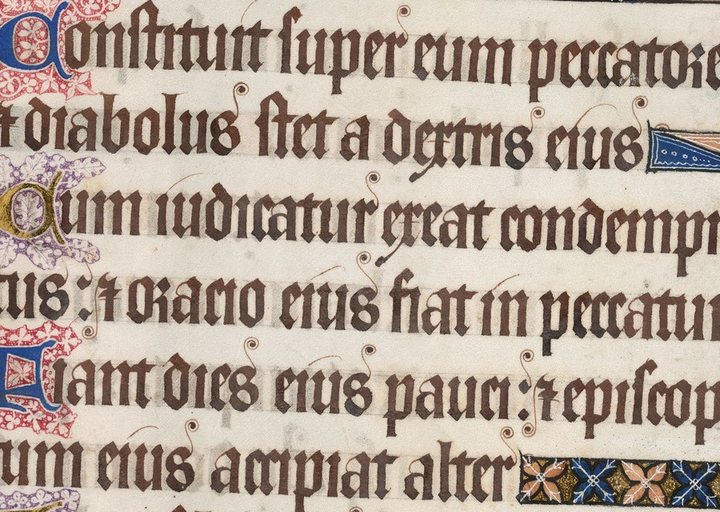
A book of psalms made in England, written with a quill in Gothic script, also called black letter. Every downstroke is thick and dark, and the short strokes that join them are thin.
在英格蘭製作的一本詩篇,用羽毛筆寫的哥德體(又叫黑體字)。每一筆豎畫都又粗又黑,連接它們的短筆畫則很細。
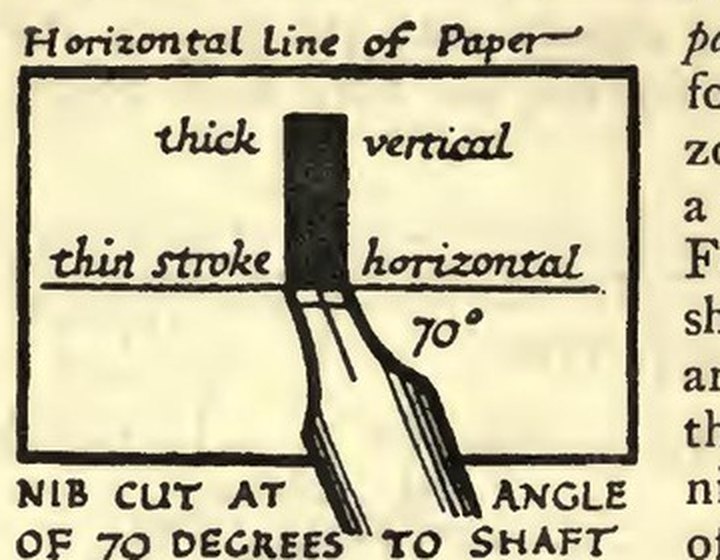
Edward Johnston studied old manuscripts and taught people to cut and use reed and quill pens again. His book explains that when the nib's edge lies along the writing line, it makes a thin stroke across and a thick stroke down.
愛德華・約翰斯頓研究古老的手抄本,重新教大家怎麼削蘆葦筆和羽毛筆、怎麼用。他在書裡說明:筆嘴的邊和書寫的橫線平行時,橫的筆畫細、豎的筆畫粗。
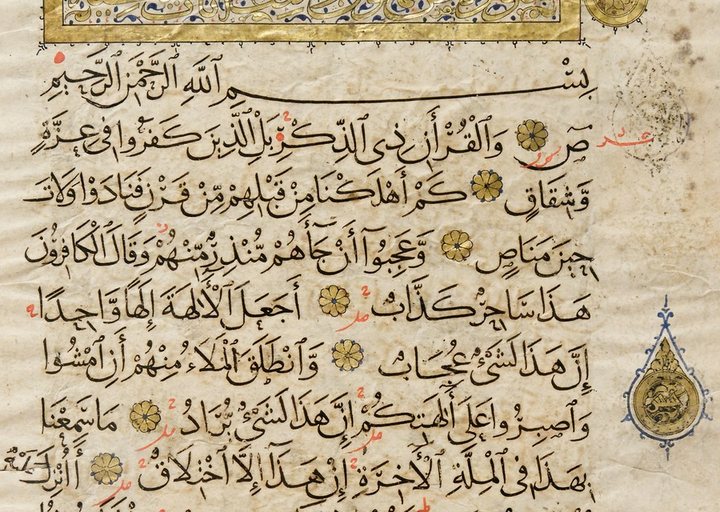
Arabic calligraphy uses a reed pen called a qalam, whose tip is sliced off at an angle. It is an edged pen too, though the script runs from right to left.
阿拉伯書法用蘆葦削成的筆,叫 qalam,筆尖是斜斜切出來的。它也是一種有「邊」的硬筆,不過字是由右往左寫的。
Practice Pad 2 · 練字板二
Now write 永 with the brush pad from Lesson 2. Here, slow means thick and fast means thin, or press harder with a stylus. Direction does not matter at all.
接著用第二課的毛筆練字板寫「永」。在這裡,寫得慢線就粗、寫得快線就細(用觸控筆的話是越用力越粗)。方向完全沒有關係。
Mouse or finger: slow = thick, fast = thin滑鼠或手指:寫得慢=粗、寫得快=細Stylus: press harder for a thicker line觸控筆:越用力線越粗
Your press-and-lift curve · 你的提按曲線
Demo · 示範 You · 你
History and Taiwan · 歷史與台灣
Three things from museums and encyclopedias, and one from Taiwan's own curriculum.
三件來自博物館和百科全書的事,和一件台灣課綱裡的事。
The Quill · 羽毛筆
An encyclopedia explains that the quill, the hollow barrel of a bird's feather, was the main writing tool in Europe from the 6th century until the middle of the 19th, and that goose feathers were the usual source. A museum that keeps medieval books adds that scribes also used swan feathers.
大英百科說:羽毛筆(鳥類羽毛中空的羽管)從六世紀到十九世紀中期,一直是歐洲主要的書寫工具,主要用鵝毛。收藏中世紀手抄本的蓋提博物館補充說,抄寫人也用天鵝的羽毛。
A Revival · 復興
By 1900, few people in Britain knew how to write with an edged pen. Edward Johnston (1872–1944) studied old manuscripts, relearned how to cut reeds and quills, and published a famous handbook in 1906. He is credited with starting the modern revival of calligraphy. He also designed the lettering of the London Underground.
到了 1900 年左右,英國已經很少人會用有「邊」的筆寫字。愛德華・約翰斯頓(1872–1944)研究古老的手抄本,重新學會怎麼削蘆葦筆和羽毛筆,1906 年出版了一本很有名的手冊。大家認為現代書法的復興是從他開始的。倫敦地鐵的字體也是他設計的。
East Asia · 東亞
The Metropolitan Museum of Art describes calligraphy as the visual art prized above all others in traditional China. It points to the brush: unlike a rigid tool such as a ballpoint pen, a flexible hair brush lets the width of a stroke change.
大都會藝術博物館說,在傳統中國,書法是所有視覺藝術裡最被看重的。它特別提到毛筆:和原子筆這類硬的工具不同,有彈性的毛筆能讓一筆的粗細產生變化。
Taiwan · 台灣
Taiwan's Ministry of Education sets out both ways of writing Chinese: vertical text runs from top to bottom and right to left, and horizontal text runs from left to right. In English class, the curriculum asks elementary students to write the 26 letters in print form; in junior high they learn to recognize joined-up handwriting too.
教育部規定了中文的兩種寫法:「中文直式書寫及排印,自上而下,自右而左」「中文橫式書寫及排印,自左而右,自上而下」。英語課方面,課綱要求國小「能書寫 26 個印刷體大小寫字母」,國中再學會「辨識連續書寫體大小寫字母」。
Myth vs. Fact · 常見迷思
✗ Myth · 迷思A broad-edge pen makes thick lines when you press hard.平頭筆用力按,線就會變粗。
✓ Fact · 事實Its tip is stiff. The width depends on direction: wide across the flat edge, thin along it.它的筆尖是硬的。粗細看方向:垂直筆嘴走是寬的,順著筆嘴走是細的。
✗ Myth · 迷思All Western calligraphy is written with a stiff pen.西洋書法都是用硬筆尖寫的。
✓ Fact · 事實Not all. Later styles such as copperplate use a flexible pointed pen, and there the thick strokes do come from pressure. This lesson is about the older broad-edge pen.不是全部。後來的銅版體(copperplate)這類寫法用的是有彈性的尖頭筆,粗的筆畫就是靠壓力來的。這一課講的是更早的平頭筆。
✗ Myth · 迷思Calligraphy means Chinese writing with a brush.書法就是用毛筆寫中文字。
✓ Fact · 事實The Chinese word 書法 is defined that way in the dictionary. But the English word calligraphy is used for beautiful writing in any script: Latin, Arabic, and many more.教育部辭典確實把「書法」解釋成「毛筆字書寫的方法」。不過英文的 calligraphy 指的是任何文字的美術書寫:拉丁字母、阿拉伯文和其他很多文字都有。
✗ Myth · 迷思One tradition is harder or better than the other.其中一種比另一種難,或比較高級。
✓ Fact · 事實They solve different problems with different tools. Both take years of patient practice.它們是用不同的工具解決不同的問題。兩種都需要好幾年耐心的練習。
Remember It · 記憶口訣
Soft brush, stiff pen.
軟的毛筆,硬的平頭筆。
Press for thick, lift for thin.
按下去粗,提起來細。
Wide across the edge, thin along it.
垂直筆嘴粗,順著筆嘴細。
Top to bottom, or left to right.
由上到下,或由左到右。
In the Classroom · 教室提醒
Classroom Activity 1 · 課堂活動一
You need · 準備材料
Steps · 步驟
Do not turn your wrist as you go around a curve. The angle of the two points should stay the same.
畫彎的地方手腕不要跟著轉。兩個筆尖的角度要從頭到尾一樣。
Classroom Activity 2 · 課堂活動二
You need · 準備材料
Steps · 步驟
There is no wrong answer here. The point is to notice what your hand had to do differently.
這裡沒有錯的答案。重點是發現自己的手做了哪些不一樣的事。
Read More · 延伸閱讀
Sources · 資料出處
Dates, names, places, and facts on this page were checked against these sources (October 2026). · 本頁的年代、人名、地名與事實依下列資料查證(2026 年 10 月)。