
← MCC Teaching Library · 英文教材庫
Intermediate Reading · Book 2 · 中級閱讀
Intermediate Reading — 第二冊
Each lesson: picture → read the text (human recording) → comprehension → words & phrases → quick quiz.
每課:看圖 → 讀文章(真人朗讀)→ 閱讀理解 → 生字片語 → 小測驗。
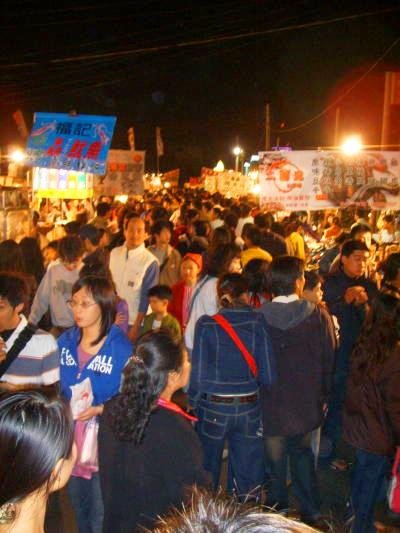
The above picture depicts a fairly typical night market scene in Taiwan. Dense crowds flow like a river through narrow paths lined with stalls. People laugh, talk, eat and drink as they weave in and out of the multitudes of pedestrians. Vendors try to peddle their wares to passersby, some by shouting to gain people’s attention and others by politely gesturing to come and have a look. The smell of fried food and sweet treats mix with the pungent aroma of stinky tofu to fill the air with strange yet enticing smells. Children yell and scream excitedly as they play games and win all sorts of cheap prizes. Young lovers stroll hand in hand, oblivious to everything around them. Fashion-conscious girls flock to tables selling sparkling jewelry and all the latest “must-have” accessories. Everyone is in search of fun, excitement and entertainment as they try to forget about the worries of daily life. If you can endure the shoulder-to-shoulder people and the noise, the night market is a great spot to spend the evening—at least millions of people across the country seem to think so.
Questions · 閱讀理解
How do vendors try and attract customers?
What fills the air?
Who flocks to the tables selling the latest “must-have” accessories?
Words & Phrases · 生字及片語
Full teaching audio · 完整教學音檔
Quick Check · 小測驗
1. According to the passage, what are two ways vendors try to sell their goods?
2. What does the passage suggest about why people go to the night market?
3. Based on the passage, what is one drawback of visiting the night market that visitors must be able to tolerate?


A twin-engine plane sits on the tarmac at an airport as the cargo is loaded. You can tell that it is not jet-powered because the engines have props. It might not be as fast as a jet, but it is still faster than anything on the ground.
The front tires on the plane are blocked to prevent the plane from rolling away before it is ready to take off. When the plane is ready to taxi to the runway, the blocks will be removed. After takeoff, the tires will disappear completely when the landing gear goes up.
The hatch on the side of the fuselage is open. The hatch is not only a door, but it also doubles as stairs for passengers to board the plane. When it is closed, it is airtight because the plane has a pressurized cabin.
The front area of the plane is called the cockpit. This is where the pilots sit and navigate the plane from. All the controls and navigational equipment are located here. This area of the plane is usually secured and only authorized personnel have access to it. Prior to 9-11, it was not uncommon for children to be given a tour of the cockpit, but this practice has been stopped for safety reasons.
Inside the plane, everyone is sitting comfortably in their seats. The flight attendant in front of them is explaining what to do in the case of an emergency. This is standard procedure on all commercial and most chartered flights. She tells them where the emergency exits, PFD’s, and oxygen masks are located.
A couple of the overhead storage compartments have their doors open, but the attendant will make sure they are all closed before take-off. These storage compartments are for carry-on luggage.Any last minute purchases at the duty free shop can also be put in them, but heavier items and checked bags are loaded into the cargo bay.
Looking out the side window, you may feel like a bird flying through the air. The clouds below form a sea of gray, stretching as far as the eye can see. The wings of the plane reach out across the sky holding the plane aloft. If it were not for the cloud cover, you would have an excellent bird’s eye view of the area below.
Questions · 閱讀理解
What is the body of the plane called?
What kind of plane is it?
What does the flight attendant do before every flight?
Words & Phrases · 生字及片語
Full teaching audio · 完整教學音檔
Quick Check · 小測驗
1. Why are the front tires blocked before takeoff?
2. Why has the practice of letting children tour the cockpit been stopped?
3. What happens to the view outside the window when there is cloud cover?
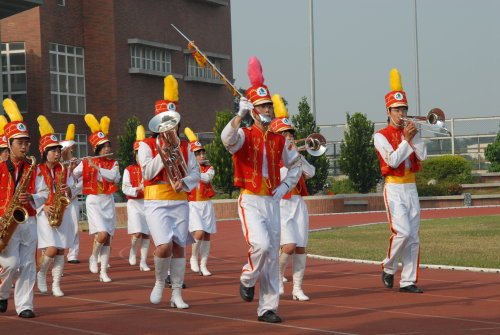
Here comes the marching band out onto the field. They are playing marching music while walking in unison around the track. They are indeed an orchestra on foot and quite a spectacle to behold.
The drum major leads the way, strutting all the while and keeping everyone in time. He twirls his baton about as he steps and even flips it high into the air and catches it again.
The musicians in red and white uniforms follow the drum major like trained soldiers heading into battle. They play brass instruments, like trumpets, saxophones and trombones; woodwinds, like flutes and clarinets; and percussion instruments, like snare drums, bass drums and cymbals.
Marching bands are kind of like musical cheerleaders. Their primary objective is to entertain the crowd at events like football games. Prior to the game, they pump up the crowd before the teams take to the field, raising the energy level. During intermissions, they kill time while the teams rest and try to keep the crowd from growing restless while they wait. Sometimes they will also sit on the sidelines and play during stoppages in the game.
Most people appreciate a good marching band and understand the dedication and hard work it takes for them to work as a well-oiled unit. Hours and hours of practice are needed so that the band can work smoothly together. I can’t imagine such commitment.
Questions · 閱讀理解
Who leads the marching band?
What does the drum major carry?
What is their primary objective?
Words & Phrases · 生字及片語
Full teaching audio · 完整教學音檔
Quick Check · 小測驗
1. Why does the marching band play during the intermission of a game?
2. What does the drum major do with the baton while leading the band?
3. According to the passage, what does it take for a marching band to work smoothly together as a unit?
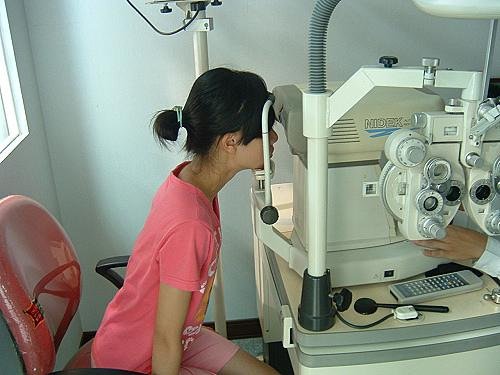
picture 1
Jenny is having her eyes checked at the eyeglass shop. She stares into a machine and focuses on a picture. The picture appears to be fuzzy and out of focus to her when in fact it is her eyes with the problem.
The optometrist adjusts dials on the machine until the picture is as clear as possible. He then presses a button on the machine and it prints out a paper with her prescription on it.
picture 2
To test the prescription, the optometrist has Jenny wear a special pair of glasses with interchangeable lenses. With these glasses he is quickly able to change lenses to tweak the focus. Jenny looks at an eye chart as he tries different lens configurations. With many people, each eye is different and may require a different prescription. It is necessary that the optometrist run this test on both Jenny’s eyes to make sure that the glasses give her the clearest vision possible.
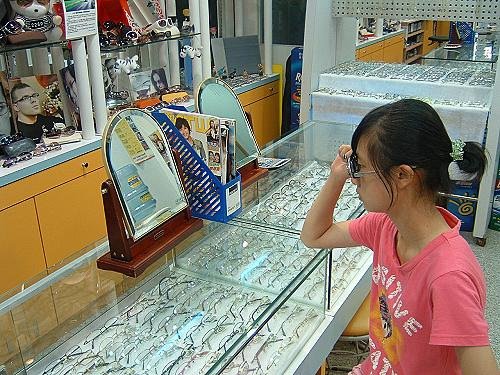
picture 3
Once the exact prescription has been determined, it is time for frame selection. If you have ever been to a store like this, you will understand what a daunting task this may be. There are literally hundreds of frames to choose from. Most stores offer styles that suit almost everyone from every walk of life. There are glasses for sports, glasses for formal occasions, designer glasses and even prescription sunglasses.
Prices can vary as much as the choices. If you are on a budget, let the sales associate know, as it might speed up the selection process by quickly narrowing down the field.
Jenny tries on many pairs and checks them out in the mirror. She narrows her choices down to about 3 pairs and then asks the assistant for the prices. Her favorite pair of the bunch is just too expensive, but the assistant tells her that they have a similar style in a less expensive brand. Jenny tries on the alternate pair and is very happy. They look almost the same and are only a fraction of the cost.
The only thing left to do is to fit the new lenses into the frames. Jenny waits around for about an hour while this is being done. Once finished, she tries them on again and the optometrist runs another quick test just to be sure the prescription is right.
The frames are also adjusted to fit Jenny’s head so that they are as comfortable as possible. Ill fitting glasses could give her a headache and she doesn’t want that, so she allows them to be bent to fit her head.
Finally, Jenny happily forks over the cash and walks out with her new glasses. She has also saved enough money to take her friend to the movies. And now that she has new glasses, she might actually be able to see the movie.
Questions · 閱讀理解
How does the picture appear to Jenny before the optometrist adjusts the dials?
What does Jenny wear to test the prescription?
Why can’t Jenny buy her favorite pair?
Words & Phrases · 生字及片語
Full teaching audio · 完整教學音檔
Quick Check · 小測驗
1. Why does the optometrist have Jenny wear special glasses with interchangeable lenses?
2. Why does the optometrist test both of Jenny's eyes separately?
3. What happens after Jenny decides she cannot afford her favorite pair of glasses?
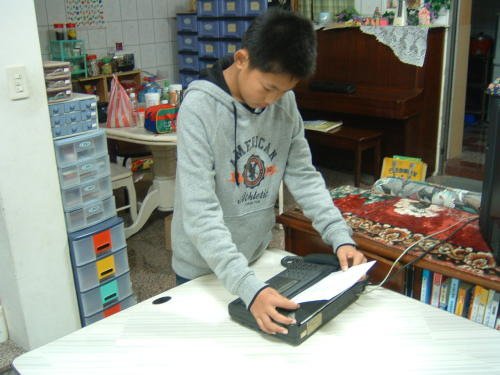
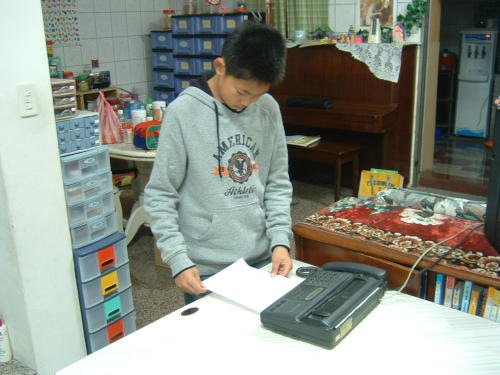
Murray is a very smart boy. In fact, he is a genius. He is so smart that he wants to skip high-school altogether. He thinks it would just be a waste of time.
A while back, the young prodigy applied to Harvard. The prestigious university received a copy of his application, but his transcript was outdated. In order to process his application before the deadline, they will need an updated copy of his transcript. But there is one small problem… the deadline is only two days away! Even if Murray couriered or mailed in the document right away it would not get there on time. How on Earth is he ever going to get the paperwork there on time?
Luckily for Murray, fax machines have been invented. He also just happens to have a copy of his current transcript in his father’s filing cabinet. Maybe there is hope after all.
After retrieving the copy of his transcript, he inserts it into the fax machine. Then he picks up the receiver and waits for the dial tone. When he hears the tone, he dials the number and then eagerly waits for response.
Suddenly, there is a god-awful electronic screech as the fax machine on the other end responds. The transcript slowly disappears into the fax as the machine scans it, converting the page into a digital signal that can be sent through the phone line.
Murray hangs up the receiver as the fax starts sending the information. Gently he holds the edge of the transcript, being careful not to pull on it, as it emerges from the bottom of the machine.
The machine lets out one final beep and the process is finished. Satisfied that the transfer is complete, Murray returns the transcript to the filing cabinet. He then rushes to sit by the phone in anticipation of Harvard’s response. Hopefully, he will hear from them soon.
Questions · 閱讀理解
Why does Murray want to skip high school?
How does Murray decide to send his transcript?
How do we know that he is excited for Harvard to call back?
Words & Phrases · 生字及片語
Full teaching audio · 完整教學音檔
Quick Check · 小測驗
1. Why was Murray's original application incomplete?
2. Why does Murray decide to use a fax machine instead of mailing the document?
3. What happens to the transcript as the fax machine scans it?
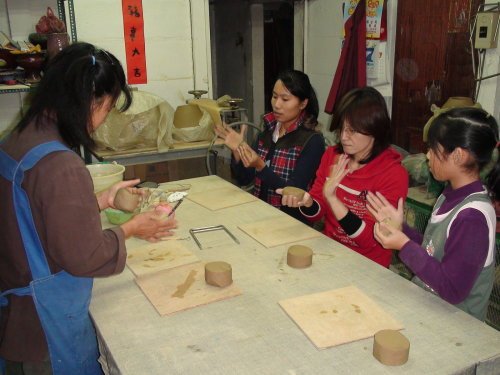
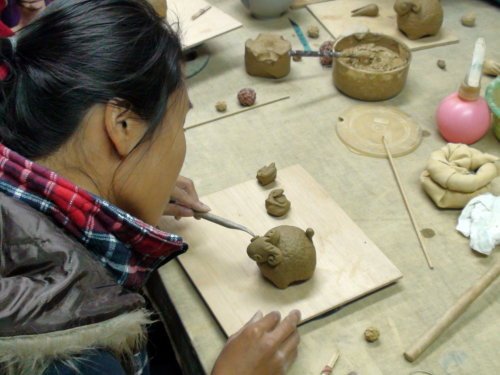
One day Sophia and her mother were bored out of their skulls. They just couldn’t think of anything to do to keep themselves entertained.
“Why don’t we go to Sichou and see if we can take a pottery class?” Susan suggested to her daughter.
“That sounds like a blast,” Sophia replied excitedly. “I’ve always wanted to work with clay.”
The two of them rushed to get ready. Then they flew out of the house and jumped in the car. In no time at all, they were parked in front of the pottery class building.
As luck would have it, they were able to get into a class without making an appointment. The owners of the shop didn’t have much going on that afternoon, so they allowed the girls to join in on a class already in progress. Normally, they wouldn’t take walk-ins, but Susan and Sophia seemed very eager.
The instructor gave each of them a slab of clay to work with. She told them they were going to learn how to make a sheep.
“I love sheep!” Sophia exclaimed. “It is my favorite animal.”
“I thought the rabbit was your favorite animal?” her mother asked.
“That was last week,” the 11 year old remarked as if her mother should know such information.
“Well, pardon me for being out of the loop,” Susan sarcastically responded. “You change your favorite animal more often than you change your underwear.”
Susan broke off a piece of the clay and rolled it into a small ball. The ball, which would become the head of the animal, was then made into a cone-like shape that was round on one end. The pointy end was split in half. Each half was curved to the side to form the horns of the ram. Details were then etched out with specialized tools to make the head look more realistic.
The body of the animal was made by flattening out the remaining clay (other than small bits that would be used to make eyes and a tail). A rough ball, perhaps made from a piece of lava rock, was rolled over the flattened clay to give it a texture that would look similar to a sheep’s coat. The large piece was then molded by hand into a more body-like shape.
The head was then attached to the body with slip and the clay finally started to look like something. The leftover bits were then made into eyes and a cute little tail, which were then secured into place. These finishing touches really made the little sheep come alive. Everything was coming together nicely.
“I’m finished,” Sophia declared. “Can I take it home now?”
The friendly teacher snickered, “It is going to be some time before you will be able to take it home. It has to be dried and then fired in the kiln.”
“Well, when will it be ready?” Sophia impatiently asked.
“About two weeks, I should think,” the teacher told her.
“Two weeks!” the little girl shrieked. “I’ll have forgotten all about it by then. I have a short attention span, you know? I’m only a kid.”
“Don’t worry. I’ll remind you,” Susan said in an attempt to calm her daughter. She knew, though, that Sophia would be asking every day whether her sheep was ready or not. Maybe even twice a day! Until Sophia’s clay sheep was sitting on here dresser in her bedroom, there would be no peace at home.
Questions · 閱讀理解
Why were Sophia and her mother so bored?
Why were they were able to get into a class without making an appointment?
What was done with the rough ball?
Words & Phrases · 生字及片語
Full teaching audio · 完整教學音檔
Quick Check · 小測驗
1. Why did the shop owners allow Susan and Sophia to join a class that was already in progress?
2. How were the horns of the ram formed from the clay?
3. Why did Susan tell Sophia not to worry about forgetting her sheep?
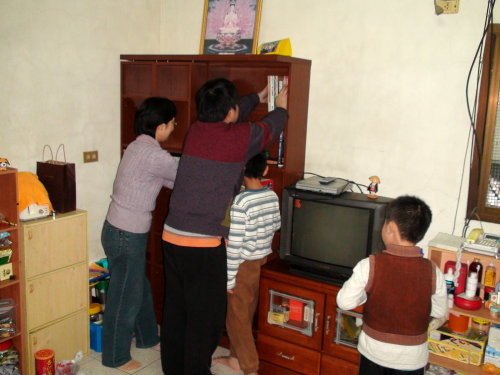
“God!” Jean cried. “We have company coming for dinner and the living room is a disaster.”
“It looks like a tornado hit it,” her husband Joe added in agreement.
“How are we ever going to make the place look presentable before they get here?” she asked in a worried voice.
“Child labor,” Joe snickered. “Hey, boys! Could you come to the living room please? I have a surprise for you.”
Their two young boys came flying into the living room. Dad knew the word “surprise” would pull them away from anything they were doing. Even though he had used the ploy many times before, they still fell for it.
“Yes, Dad?” Jack said with a look in his eyes that said he was hoping for a new toy or a chocolate bar at the very least.
“Where’s our surprise, Dad?” Kyle, the younger of the two brothers, asked his father.
“Oh, were you expecting something?” Joe said looking like he had no idea what they were talking about.
“You said ‘I’ve got a surprise for you’, so what do you think?” Jack, realizing he had been tricked, sharply snapped.
“Surprises come in many shapes and sizes, you know? This surprise just happens to come in the form of work,” Joe sounded like a deranged circus clown trying to lure small children into his tent.
Jean could only shake her head at her husband’s words. She couldn’t believe that he would resort to such measures. But, on the bright side, the living room would get cleaned and that was foremost on her mind at the moment.
After the kids got over the initial shock of being deceived by their father, the family started the cleaning process. Jean delegated the duties. The kids were to pick up their toys, schoolbooks and things that they had left lying on the floor or hadn’t put away. Joe organized the bookshelf and tidied up around the entertainment center. Jean also dusted, swept and mopped. In no time at all, the living room was spic and span.
“I feel bad about tricking you boys into helping us out,” Joe confessed. “How about tomorrow, I take you out for a real surprise to make up for it. We’ll go to the zoo.”
The boys screamed with delight. Maybe their father wasn’t so evil after all.
Questions · 閱讀理解
Why was Jean worried about the living room being a disaster?
What did Joe do to trick the kids into coming to the living room?
What was Joe going to do to make up for tricking the kids?
Words & Phrases · 生字及片語
Full teaching audio · 完整教學音檔
Quick Check · 小測驗
1. Why did Joe call the boys into the living room?
2. How did Jack react when he realized there was no real surprise?
3. What task did Jean do while cleaning the living room?
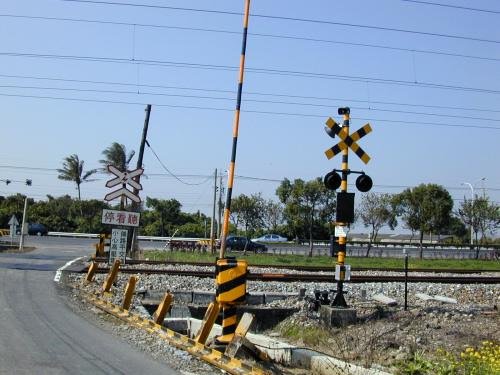

Ding, ding, ding, ding… The bell at the railway crossing sounded and the warning lights began to flash. Two poles acting as barricades, one on either side, slowly lowered to block both lanes of traffic.
“God, I hate waiting at railway crossings!” an angry man yelled out loud inside his car then hit the palms of his hands against the steering wheel.
The impatient man looked both ways, but couldn’t see a train coming in either direction. This seemed to infuriate him even more. His blood pressure rose.
“There isn’t even a damned train coming yet. I could’ve been halfway home by now,” he cussed.
The ringing of the warning bell was only there to agitate him and to make the wait as annoying as possible, he thought. At that moment, everything seemed like a conspiracy put in place to impede his daily commute.
“Well, it is about bloody time!” the man said as he felt the ground begin to rumble and heard the sound of a distant train getting closer. The vein in his forehead slowly sunk back into hiding and fleshy colors, other than red, returned to his face.
Suddenly, the brakes on the train began to screech and the train rolled to a halt blocking the road.
“You’ve got to be kidding me?” the man half laughed, but he was in no way amused with the situation. “Why do these things only happen to me?”
Yes, only to him, he thought. Such things never happen to other people. He wondered why he even bothers to get out of bed in the morning?
Perhaps, the cranky man didn’t see the traffic lined up behind him. Or maybe he imagined that all the other cars were empty. For whatever the reason, he continued to sulk in a cloud of his own selfish misery until the train finally passed. Then he sped away in a panic, feeling like precious time had been stolen from his miserable life, time that he would never get back. In his mind, waiting for the train to pass was a waste of time, but in reality he had only made it that way.
Questions · 閱讀理解
Why did the man hit the steering wheel?
What infuriated him even more?
Who did he think such things happened to?
Words & Phrases · 生字及片語
Full teaching audio · 完整教學音檔
Quick Check · 小測驗
1. What made the man's anger start to fade?
2. What happened right after the train reached the crossing?
3. According to the passage, what is the real reason the man felt his time was wasted?
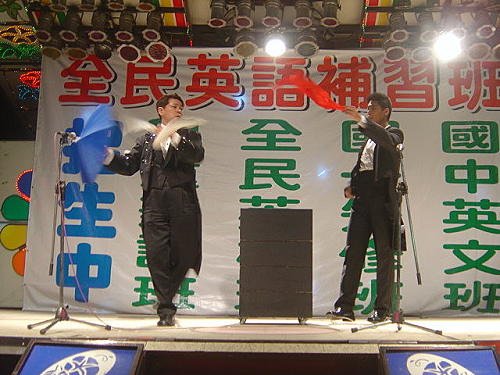
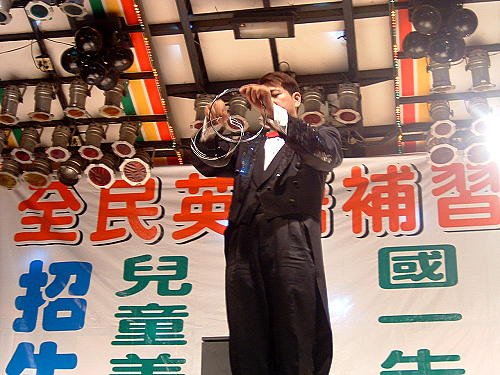
My cram school put on a Christmas concert this winter. It was a celebration for the whole school. As well, it was a chance for the students to show off their English abilities by singing songs.
My favorite performance was by a couple of magicians that the director had hired. They were really good. Both of the men wore black tuxedos with tails and looked very sharp.
Their first trick was with a bunch of colored hankies. They juggled them about and tossed them back and forth. The older magician placed one of the hankies over the palm of his hand. He waved his free hand hypnotically over the top and chanted a strange word, “abracadabra.” He quickly pulled the handkerchief away and voila...a beautiful white dove appeared perched on his finger. Everyone was in awe.
Their second act wasn’t nearly as impressive as making a dove appear out of thin air, but it was sort of entertaining. The older magician started off with an impressive ring juggling display. He then tapped the rings against one another and somehow they locked together. A member of the audience was asked onto the stage to try and separate the rings again, but she couldn’t. Then right in front of her, he miraculously pulled them apart again. She was amazed and started giggling nervously.
I know that magic is only an illusion, but it is still pretty neat that people can be fooled so easily. It must have taken the magicians a lot of practice to make the tricks so believable. But if they really wanted to impress me, they should have made the school disappear. Now that would be a trick worthy of applause.
Questions · 閱讀理解
Who hire the magicians?
What appeared when he pulled the hanky away?
Is magic real?
Words & Phrases · 生字及片語
Full teaching audio · 完整教學音檔
Quick Check · 小測驗
1. What kind of event did the cram school hold this winter?
2. What happened when the audience member tried to pull the locked rings apart?
3. What does the narrator jokingly say the magicians should have done to truly impress them?
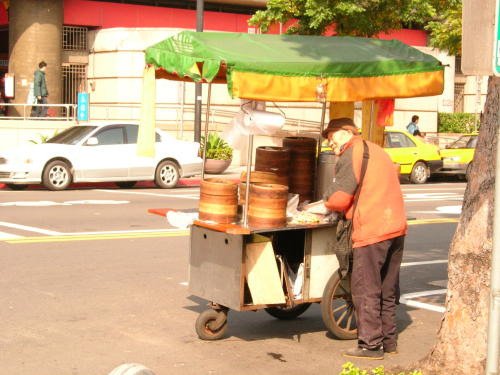
Food carts are very common on the streets of rural Taiwan and even in the larger cities. In fact, it is very difficult to go down a street in this country without seeing one. They are seemingly everywhere.
A handsome old man owns this particular cart (pictured above). Every day, he wakes up early and pushes the cart to his favorite selling location and sets up shop. He has been doing it for many, many years.
The cart is kind of like a restaurant on wheels and has everything he needs to make steamed buns. There may not be a huge selection of menu items like a regular restaurant, but what it lacks in variety it makes up for in versatility. This is because if business isn’t good in one spot, it can easily be moved to a new location.
The stackable steam trays that the buns are placed in are made from bamboo. They are placed over boiling water that is heated with a propane burner. As the hot steam rises through the center of the trays, it cooks the delicious buns.
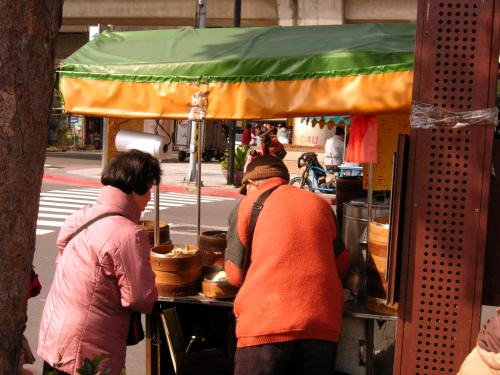
The smell of the cooking buns quickly draws in customers. A patron wearing a pink jacket (second picture) examines the buns and decides to buy some. The elderly fellow lifts the lid on the steamer and picks the hot buns out with tongs. He then puts each one into a bag. They have to be separated because if he were to put them all in one bag, they would stick together. The lady hands him some money in exchange for the goods.
The old man will continue to sell the steamed buns until they are all gone or until he is tired and wants to go home. Some days are better than other, but he always returns the next day to his favorite street corner under the shade of an old tree. He might even be there now as you read this.
Questions · 閱讀理解
How common are food carts in Taiwan?
Why is versatility important?
What are the steam trays made from?
Words & Phrases · 生字及片語
Full teaching audio · 完整教學音檔
Quick Check · 小測驗
1. Why does the old man push his cart to a favorite selling location every day?
2. Why does the old man put the steamed buns into separate bags instead of one bag?
3. What happens to the water under the steam trays to cook the buns?
*10 lessons in this booklet · 本冊共 10 課。